SEO vs PPC: Organic vs Paid Search on a Fixed Budget

Summarize this article with AI


SEO vs PPC for a Shopify store with a fixed budget: cost per click vs cost per page, click share data, when to move spend, and a worked $3,000 budget split.
SEO vs PPC comes down to one trade: PPC (paid search, usually Google Ads) buys clicks today and stops the day you stop paying; SEO (organic search) costs time and content up front, then keeps sending clicks without a per-click fee. For a Shopify merchant with a fixed marketing budget, the right answer is rarely one or the other. It is to keep paying only for the searches that are profitable now, and to move the rest of the money into pages that will rank for the searches your ads have already proven.
This guide compares organic search vs paid search on the numbers that matter to a store: cost structure, time to results, share of clicks (from studies we checked, not marketing folklore), when to shift budget, and how paid data should feed your SEO. It ends with a worked budget example you can redo with your own figures.
SEO vs PPC: the short comparison
SEO (organic search) | PPC (paid search) | |
|---|---|---|
How you pay | Time, content, tools; no fee per click | Every click, priced by auction |
Time to first results | Weeks to months, often longer | Same day once ads are approved |
When you stop paying | Rankings fade slowly | Traffic stops at once |
Share of clicks (US, all searches) | 70.5% of clicks go to organic results | About 1% of clicks go to ads |
Control over message and landing page | Partial: Google may rewrite titles and snippets | Full: you write the ad and pick the page |
Speed of testing | Slow; one change takes weeks to read | Fast; A/B test ads in days |
What you own at the end | Pages that can keep ranking | Data on which searches convert |
Best for | Evergreen product and category demand | Launches, sales, brand defense, testing |
The one row worth rereading is "what you own at the end". Every dollar of PPC rents a position. Every dollar of SEO, if it works, leaves behind a page that can keep ranking. That is why the question for a fixed budget is not "which is better" but "which searches deserve rented traffic and which deserve owned traffic".
How the cost structures differ
PPC: you pay per click, forever
In Google Ads you pay each time someone clicks your ad, at a price set by auction. The cost of a click has nothing to do with whether it turns into an order, so the math every merchant needs is the break-even ROAS: 1 divided by your gross margin. At a 60% margin, break-even ROAS is 1 / 0.60 = 1.67. A campaign returning $1.65 in revenue for every $1 spent is losing money once product costs are paid, even though it "makes sales". Our ROAS calculator does this for you.
The flip side is the maximum you can pay for a click without losing money: AOV × conversion rate × gross margin. A $55 order, a 3.75% conversion rate and a 60% margin give $55 × 0.0375 × 0.60 = $1.24 per click. Anything above that is a loss on the first order.
SEO: you pay for pages, not clicks
Organic clicks are free at the moment they happen. The cost sits upstream: writing collection and guide pages, fixing product page titles and descriptions, earning links, and keeping the store fast. On Shopify, most of the on-page work happens in the admin: each product, collection and page has a search engine listing section(opens in a new tab) where you edit the title Google shows and the meta description. Speed matters too, because a slow store wastes both kinds of traffic; our guide to Shopify speed optimization covers what actually moves the needle.
The catch is that SEO cost is front-loaded and the payoff is uncertain. You can spend three months on content that never reaches page one.
Time to results: days vs months
PPC is on the day your campaign is approved. SEO is slower, and the data says slower than most people plan for. Google itself says that some changes could take several months(opens in a new tab) to show in search results, and that you should usually wait a few weeks before judging whether a change helped.
Ahrefs looked at 1 million pages(opens in a new tab) first seen by its crawler in September 2023 and found that only 1.74% of newly published pages reached the top 10 within a year. In the same study, the page in position 1 was on average 5 years old. For a small store, that means SEO money spent this quarter is a bet on next year's revenue, and PPC is what pays this month's bills.
Organic vs paid search statistics: who gets the clicks
The strongest argument for SEO is where people actually click. SparkToro's 2024 zero-click study(opens in a new tab), built on a clickstream panel from Datos (a Semrush company) covering September 2022 to May 2024, found that in the US:
- 58.5% of Google searches ended without any click (zero-click searches);
- of the searches that did produce a click, 70.5% went to unpaid organic results;
- about 1% went to a paid ad.
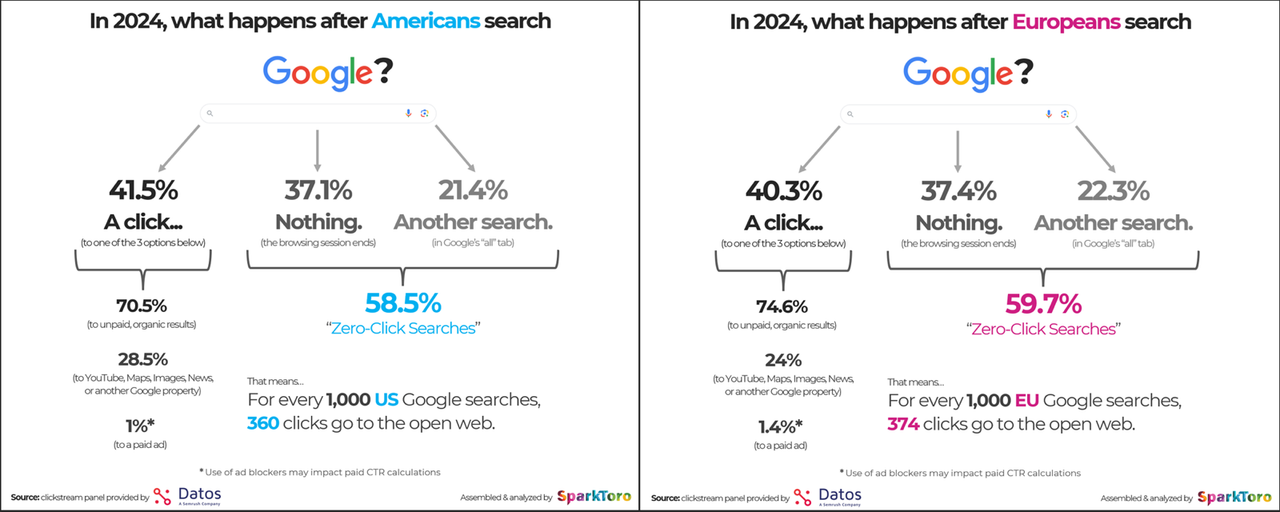
Two caveats keep this honest. SparkToro notes the 1% includes billions of searches where no ad was shown at all, and that ad blockers may lower the measured paid share. On commercial queries ("buy linen sheets", "vitamin c serum"), ads take a far larger share. But the direction is clear: across all searches, organic results receive many times more clicks than ads.
Organic clicks are also getting scarcer. Pew Research Center tracked 900 US adults(opens in a new tab) in March 2025 and found that people clicked a traditional search result on 8% of visits to a page with an AI summary, against 15% on pages without one. Only 1% of visits included a click on a link inside the summary itself.
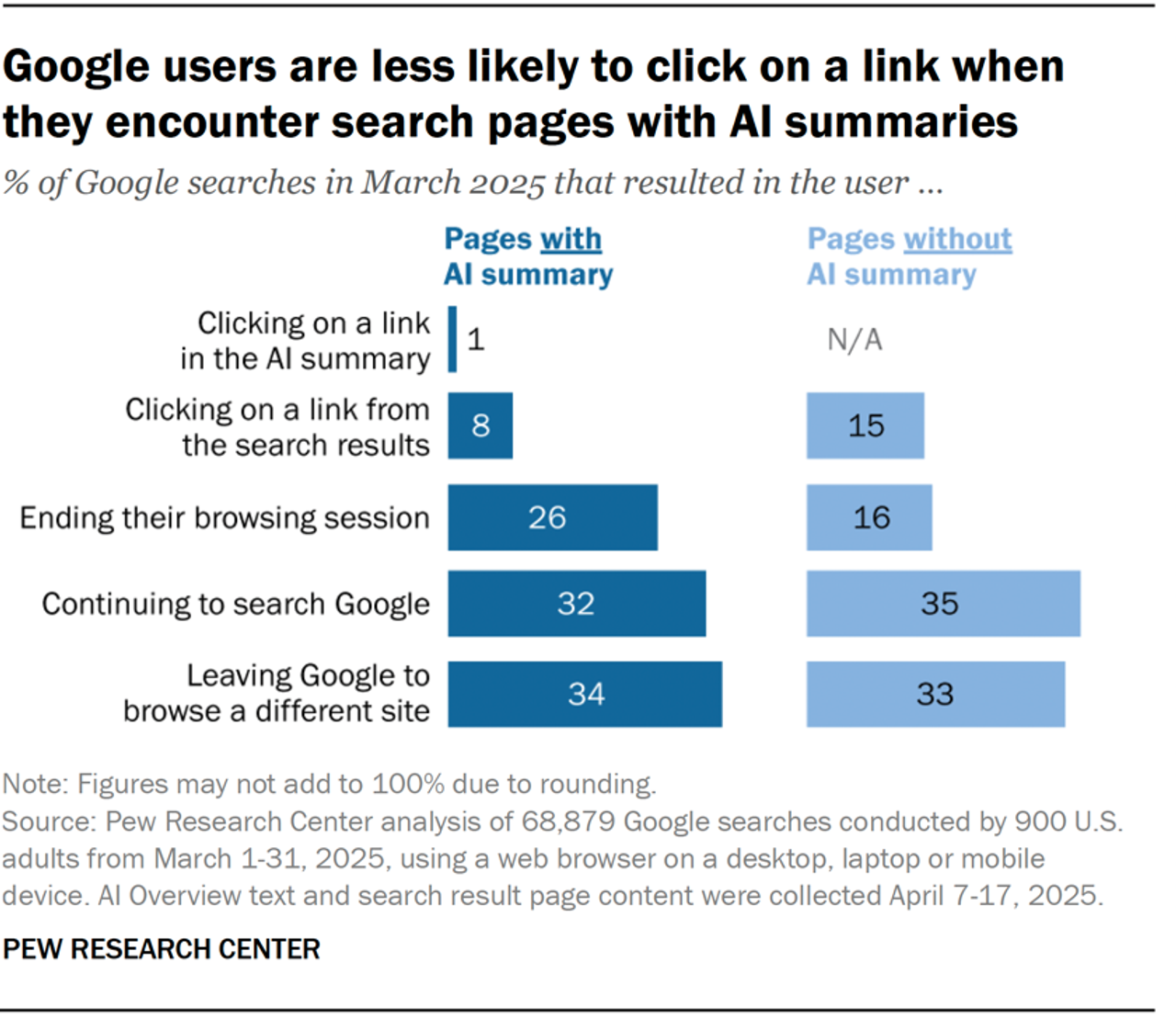
What this means for a store: informational queries ("how to choose a running shoe") are the ones most likely to get an AI summary and the fewest clicks. Product and collection queries still send shoppers to stores. Point your SEO effort at the second group first.
Do SEO and PPC cannibalize each other?
A common worry is that ads steal clicks you would have received organically for free. Google's own research answers this directly. A 2011 meta-analysis of Search Ads Pause studies(opens in a new tab) found that, on average, 89% of ad clicks were incremental: when advertisers paused their ads, organic clicks did not replace them. A 2012 follow-up(opens in a new tab) found that when the advertiser already ranked first organically, about 50% of ad clicks were still incremental, and that 66% of ad clicks happened on searches where the advertiser had no organic result at all.
Google's research is Google's, so read it with that in mind. But the practical takeaway holds: turning off ads on searches where you rank #1 saves money, but only about half of those clicks come back as organic. Test it on your own brand terms before cutting.
There is also evidence that the two help each other. A 2009 NYU Stern study(opens in a new tab) by Anindya Ghose and Sha Yang found that when paid and organic listings appeared together, combined click-through rates were 5.1% higher and conversion rates 11.7% higher than with organic listings alone. The data is old, but it matches what most stores see: a brand that shows up twice on the same results page looks more established.
One thing that does not happen: paying for ads does not lift your rankings. Google states in its help page for the paid and organic report that "investment in paid search has no impact on your organic search ranking."(opens in a new tab)
How paid search data should guide your SEO
This is where a fixed budget gets more out of both channels. PPC is the fastest way to learn which searches turn into orders; SEO is the cheapest way to keep receiving them.
- Pull the search terms report. In Google Ads, the search terms report(opens in a new tab) lists the exact queries that triggered your ads, with clicks, cost and conversions. Sort by conversions, then by cost per conversion.
- Tag each converting query by page type. "Organic cotton bath towels" belongs to a collection page. "Best towels for a gym bag" belongs to a guide that links to that collection.
- Link Search Console to Google Ads and open the paid and organic report(opens in a new tab). It shows, query by query, whether you get ad clicks, organic clicks or both. Queries with strong ad conversions and weak organic visibility are your SEO shortlist.
- Write or rewrite one page per shortlisted query. Put the query in the collection title, the SEO title and the first paragraph, and use the ad copy that won (headlines with the best click-through rate) as a starting point for the meta description.
- Reduce bids, don't delete keywords, once the page ranks. Watch total clicks (paid + organic) for that query. If they hold steady while ad spend falls, keep lowering bids; if they drop, the ad was incremental and deserves its budget.
On a Shopify store, also install the Google & YouTube app(opens in a new tab). It syncs your catalog to Google Merchant Center, which makes eligible products show in free listings on the Shopping tab, and feeds your Shopping and Performance Max campaigns from the same product data.
When to shift budget from PPC to SEO (and back)
Shift money toward SEO when:
- a group of non-brand keywords runs below your break-even ROAS for 30 days or more, and the search terms are informational ("how to", "best", "vs");
- you pay for clicks on queries where you already rank in the top three organically, and a pause test shows most of those clicks come back;
- your best-converting paid queries land on a product page when a collection or guide page would serve them better;
- CPCs on your core terms keep rising faster than your AOV.
Keep or move money into PPC when:
- you launch a product, a collection or a seasonal sale and need sales this week;
- a keyword converts profitably and you have no page that could rank for it within six months;
- competitors bid on your brand name (brand campaigns are usually the cheapest clicks you will buy);
- you are testing whether a new market or product line sells at all. Paid data in 30 days beats guessing for a year.
Worked example: a $3,000 monthly budget
Take a store that spends its whole $3,000 monthly marketing budget on Google Ads. Average CPC is $1.00, AOV is $55, gross margin is 60%. These are illustrative figures; swap in yours.
Campaign group | Spend | Clicks | Conv. rate | Orders | Revenue | ROAS | Gross profit after ads |
|---|---|---|---|---|---|---|---|
Brand, product names, Shopping | $2,000 | 2,000 | 3.75% | 75 | $4,125 | 2.06 | +$475 |
Broad informational keywords | $1,000 | 1,000 | 1.5% | 15 | $825 | 0.83 | −$505 |
Total | $3,000 | 3,000 | 3% | 90 | $4,950 | 1.65 | −$30 |
Overall, revenue looks fine ($4,950 on $3,000 of spend) but the account loses $30 a month once product costs are paid, because a ROAS of 1.65 sits just under the 1.67 break-even. Split by query type, the problem is obvious: brand, product-name and Shopping traffic is profitable, and broad informational queries lose $505 a month.
The plan, within the same $3,000:
- Keep the $2,000 on brand, product-name and Shopping campaigns. Gross profit: $4,125 × 0.60 − $2,000 = $475.
- Cut the $1,000 of broad informational keywords. You lose 15 orders, but you stop losing $505 a month.
- Spend $500 a month on SEO: two collection or guide pages a month targeting exactly the informational queries the ads proved can convert, plus title and meta description fixes on existing collections.
- Keep $500 in reserve for a launch or a sale, or put it into conversion work that helps both channels.
Month one: $475 − $500 = −$25 a month, about the same as before (−$30), but with pages being built. Now suppose that six months later those pages bring 1,000 organic visits a month and convert at the same 1.5% the paid clicks did: 15 orders × $55 = $825 in revenue and $825 × 0.60 = $495 in gross profit, with no click cost. The month becomes $475 + $495 − $500 = +$470, on the same budget. That organic traffic figure is an assumption, and the Ahrefs data above shows it may take longer, which is why you keep the profitable paid campaigns running while you wait.
The lever that lifts both channels: order value
Both channels end on the same product pages and the same cart, so anything that raises what each visitor spends improves both at once. In the example, raising AOV from $55 to $60 on the 75 paid orders turns $4,125 into $4,500 and lifts ROAS from 2.06 to 2.25. It also raises the maximum profitable CPC from $1.24 to $60 × 0.0375 × 0.60 = $1.35, so you can stay in auctions competitors drop out of. The average order value guide lists the levers; volume discounts and bundles are among the easiest. Snap Bundle(opens in a new tab) adds volume discounts, mix-and-match bundles and free gifts to Shopify product pages, and is free until bundles bring in $500 a month, then $12.99 a month with no order cap. Our themes also include AOV features built in, such as cart upsells.
Visitors who don't buy are the other half: abandoned cart emails recover part of the traffic you already paid for, whether it came from an ad or a ranking. And predictive search helps the shoppers who land on a guide page find the product they came for.
Which is better for a Shopify store?
For most stores with a fixed budget: PPC for searches that convert profitably today and for anything time-bound, SEO for the searches your ads have proven but can't buy profitably, and conversion work for everything in between. Start from your search terms report, not from a channel preference.
If you want both channels to pay back faster, raise what each visitor spends. A higher AOV lifts ROAS on every paid click and the value of every organic visit, and Snap Bundle(opens in a new tab) is a free way to start with volume discounts and bundles.
Once you commit to organic, our Shopify SEO guide covers the store-side work: collections, product pages, speed and blog content.
FAQ
Is SEO better than PPC?
Neither is better in general. PPC is better for fast, measurable sales and for searches that convert profitably at today’s CPC. SEO is better for steady demand you can rank for, because organic clicks cost nothing once the page ranks and organic results get most clicks overall.
Should I invest in SEO or Google Ads first?
A new store with no rankings usually starts with Google Ads on brand, product-name and Shopping queries to get sales and learn which searches convert. Start SEO at the same time on the pages those ads prove, since rankings take months.
What is the click-through rate of organic vs paid search?
Across all US Google searches, SparkToro and Datos(opens in a new tab) found that 70.5% of clicks went to organic results and about 1% to paid ads, with 58.5% of searches ending without a click. On commercial queries the paid share is much higher.
Does running Google Ads improve my SEO rankings?
No. Google states that investment in paid search has no impact on organic ranking. Ads help SEO indirectly, through the query and conversion data they give you.
How long does SEO take compared to PPC?
PPC can bring traffic the day ads go live. SEO changes can take several months to show, and Ahrefs found(opens in a new tab) that only 1.74% of new pages reached the top 10 within a year.
What is the difference between SEO, SEM and PPC?
SEO is earning unpaid rankings in search results. PPC is paying per click for ads, in search or elsewhere. SEM (search engine marketing) is used either for paid search only or for both together, depending on who you ask.

Keep reading

Shopify Email Flows: 7 Automations That Earn Without Ad Spend
The seven Shopify email flows that turn traffic you already paid for into revenue: timing, content and setup in Shopify Messaging and Klaviyo, with 2026 benchmarks.

What Is a Shopify CRO Agency? What CRO Means, What It Costs, and Whether You Need One (2026)
What conversion rate optimization (CRO) is, what a Shopify CRO agency actually does, what it costs, the benefits for your store, and the quick wins to try before hiring one.

Shopify SEO: The Guide to Free Traffic That Replaces Paid Clicks
Shopify SEO step by step: site structure, collection and product pages, duplicate URLs, admin SEO fields, structured data, Core Web Vitals, blog and Search Console.