
What Is a Shopify CRO Agency? What CRO Means, What It Costs, and Whether You Need One (2026)

Summarize this article with AI


What conversion rate optimization (CRO) is, what a Shopify CRO agency actually does, what it costs, the benefits for your store, and the quick wins to try before hiring one.
A Shopify CRO agency is a team that helps Shopify merchants turn more of their visitors into customers. It studies how people move through your store, finds where they give up, changes your theme, apps or offers to fix it, and tests those changes to keep only the ones that raise sales. You pay it to get more revenue out of the traffic you already have, not to bring in new traffic.
This guide explains what CRO is, what an agency does day to day, what it costs, the benefits for a merchant, and how to tell if your store needs one yet.
What is CRO (conversion rate optimization)?
CRO, or conversion rate optimization, is the work of increasing the share of visitors who take the action you want, usually placing an order. Your conversion rate is a simple ratio:
Conversion rate = orders ÷ sessions × 100
A store with 10,000 sessions and 140 orders in a month has a conversion rate of 1.4%. CRO tries to raise that number by removing what stops people from buying: a page that loads slowly, a shipping cost that appears too late, a product page with no reviews, a checkout that asks for an account.
A "conversion" is not always a purchase. A store can also track smaller steps, called micro-conversions: adding to cart, starting checkout, joining the newsletter. Watching those steps shows where in the journey visitors drop off.
CRO is not a list of tricks. It is a method: measure, form a hypothesis, change one thing, test it against the original, keep what wins.
What is a Shopify CRO agency?
A CRO agency specializes in that method. A Shopify CRO agency applies it to Shopify stores specifically, which matters more than it sounds. It knows:
- The theme layer. Most changes happen in Liquid, sections and theme settings. An agency that can't code a theme is limited to suggestions.
- The app ecosystem. Many conversion problems on Shopify come from apps: too many of them slowing the store, or the right one missing.
- Checkout limits. Shopify's checkout can only be customized in certain ways, and Shopify Plus unlocks more. A Shopify specialist knows what is possible on your plan.
- Shopify's data. Shopify Analytics, its conversion funnel report, and the tools that plug into it.
It differs from a regular Shopify development agency, which builds what you ask for. A CRO agency decides what to build from data, then proves whether it worked.
What does a Shopify CRO agency do?
Most agencies follow the same five steps, whatever they call them.
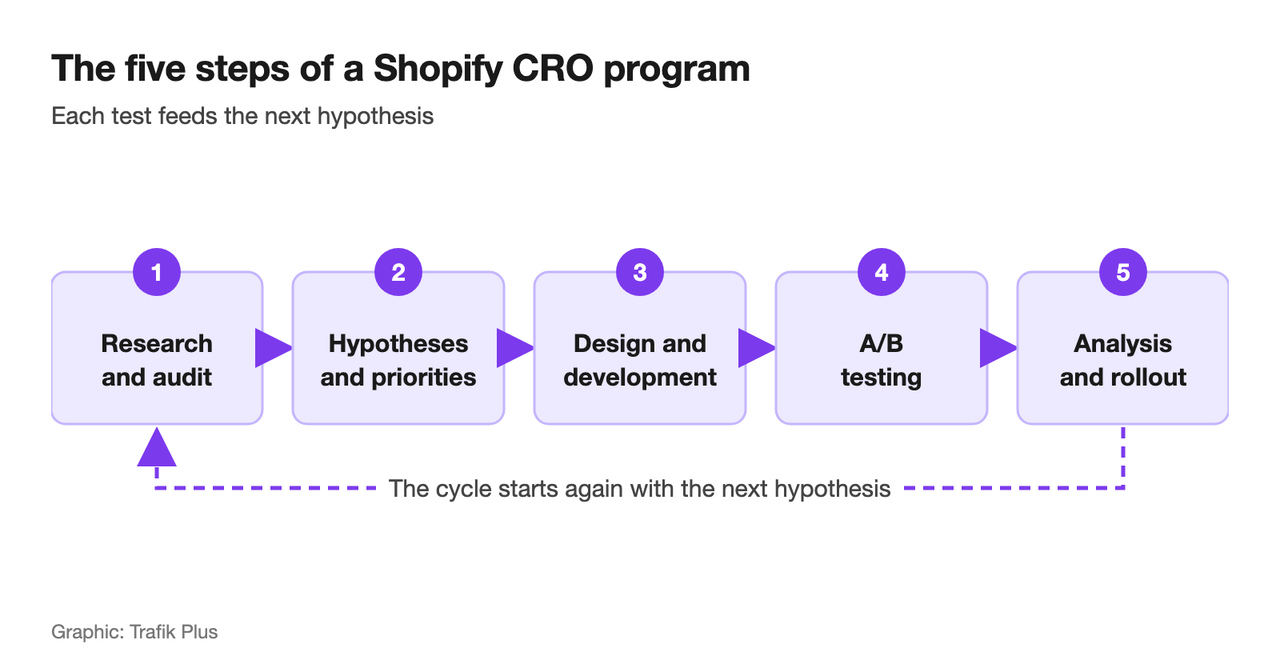
1. Research and audit
The agency starts by finding where you lose sales. It goes through your analytics funnel (product page, cart, checkout, order), watches session recordings and heatmaps, runs customer surveys, and reviews the store page by page against known usability problems. The output is a list of issues, each with evidence.
2. Hypotheses and priorities
Each issue becomes a hypothesis: "If we show the delivery date next to the add to cart button, more mobile visitors will add to cart, because surveys show delivery time is their main doubt." The agency then ranks hypotheses by expected impact, confidence and effort, so the first tests are the ones most likely to pay.
3. Design and development
Designers and Shopify developers build the variant: a new product page layout, a cart drawer with upsells, a different offer. This is where Shopify expertise counts.
4. A/B testing
The variant runs against the original, with traffic split between them, until there is enough data to call a winner. Since June 2026(opens in a new tab), Shopify's own Rollouts(opens in a new tab) feature can A/B test two whole themes or checkout setups. Agencies also use dedicated testing apps to test single elements.
5. Analysis and rollout
Winners go live for everyone. Losers are documented too: a test that fails still tells you something about your customers. Then the cycle starts again with the next hypothesis.
What a CRO agency usually works on
Area of the store | What usually goes wrong | What a CRO agency tests |
|---|---|---|
Product page | No reviews near the price, photos that only show the packaging, unclear delivery date | Review stars by the price, benefit-led images, delivery estimate by the add to cart button |
Collection pages | Hard to filter, too many clicks to add a product | Filters and sorting, quick add to cart, product badges |
Cart | Shipping cost appears late, nothing to add, no reason to spend more | Free shipping progress bar, cart upsells, quantity discounts |
Checkout | Forced account creation, few payment methods, surprise fees | Guest checkout, express payments (Shop Pay, Apple Pay), costs shown earlier |
Speed | Heavy apps and images slow down every page | Removing unused apps, lighter images, fewer scripts |
Navigation and search | Visitors cannot find the product they came for | Menu structure, predictive search, landing pages per ad campaign |
The benefits of CRO for Shopify merchants
Your ad budget goes further
This is the main reason merchants invest in CRO. Raising the conversion rate makes every visitor worth more, whether they came from an ad, an influencer or Google. Take a store with 10,000 sessions a month, a $60 average order and $3,000 in ads:
Before CRO | After CRO | |
|---|---|---|
Sessions per month | 10,000 | 10,000 |
Conversion rate | 1.4% | 1.8% |
Orders | 140 | 180 |
Revenue (at $60 per order) | $8,400 | $10,800 |
Ad spend | $3,000 | $3,000 |
ROAS | 2.8 | 3.6 |
Ad cost per order | $21.43 | $16.67 |
Same traffic, same ad budget: 40 more orders, $2,400 more revenue a month, and each order costs $4.76 less in ads. You can check your own numbers with our ROAS calculator. Better unit economics also mean you can afford to bid higher on ads than a competitor who converts worse.
Bigger orders, not only more orders
CRO also works on average order value. Offers like quantity discounts, mix and match bundles or upsells in the cart raise what each customer spends. A test can tell you which one your customers respond to, instead of guessing.
Faster pages sell more
Speed is one of the most measurable levers. In Google and Deloitte's "Milliseconds make millions" study(opens in a new tab), a 0.1 second improvement in mobile site speed raised retail conversions by 8.4%, and retail shoppers spent 9.2% more. CRO agencies often start by removing apps and scripts the store no longer needs.
Decisions based on evidence
Without testing, redesigns are bets. A redesign that looks better can still sell less. CRO replaces opinions ("I think the button should be green") with results, and stops you from shipping a change that quietly costs sales.
You learn who your customers are
Surveys, recordings and test results show why people buy and why they hesitate. That knowledge feeds everything else: ads, product pages, emails, even which products to launch next.
The gains add up
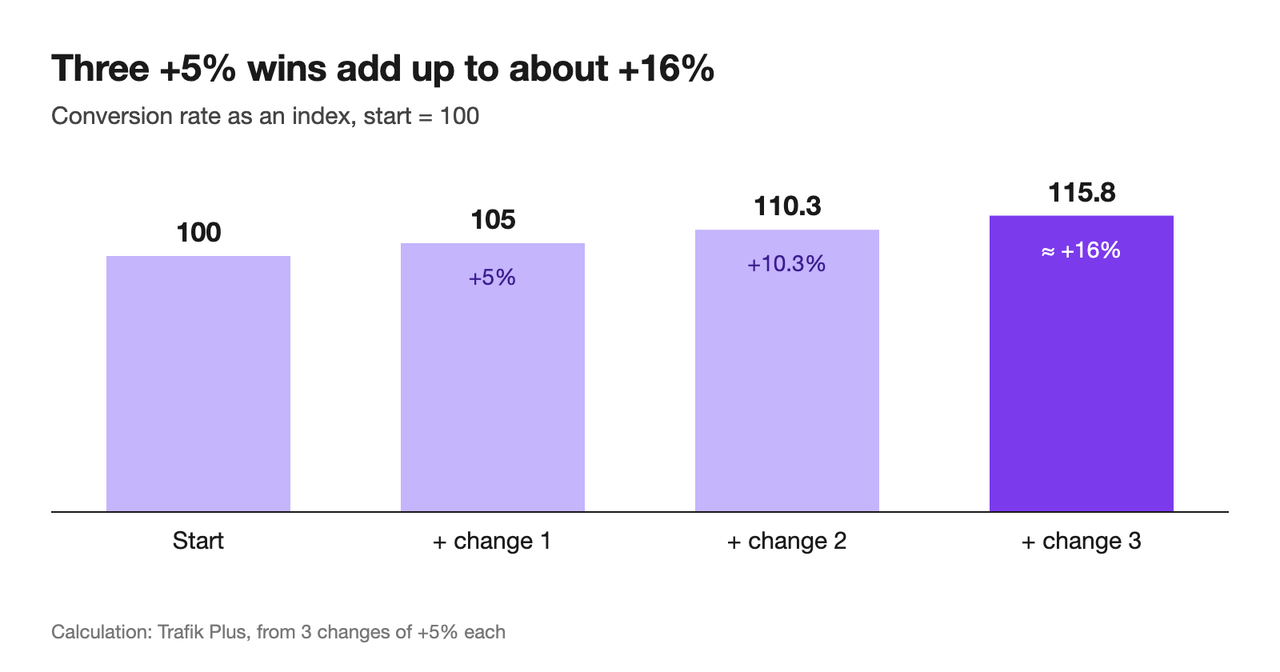
A conversion gain keeps paying every month on all future traffic. And several small wins multiply: three changes that each add 5% to conversions add about 16% together.
What is a good conversion rate on Shopify?
Littledata's benchmark(opens in a new tab), based on 426 Shopify stores between July and October 2026, gives these figures:
Shopify store | Conversion rate |
|---|---|
Median store | 1.4% |
Top 20% | Above 2.7% |
Top 10% | Above 3.5% |
Conversion rates vary a lot by industry, price and traffic source, so compare your store with its own past results first. A $1,000 sofa will never convert like a $20 T-shirt.
Why shoppers leave without buying
Baymard Institute(opens in a new tab) puts the average cart abandonment rate at 70.22%, across 50 studies. Leaving aside visitors who were only browsing, the most common reasons are:
- Extra costs too high (shipping, taxes, fees): 40%
- Delivery too slow: 20%
- Didn't trust the site with their card details: 19%
- Forced to create an account: 18%
- Checkout too long or complicated: 17%
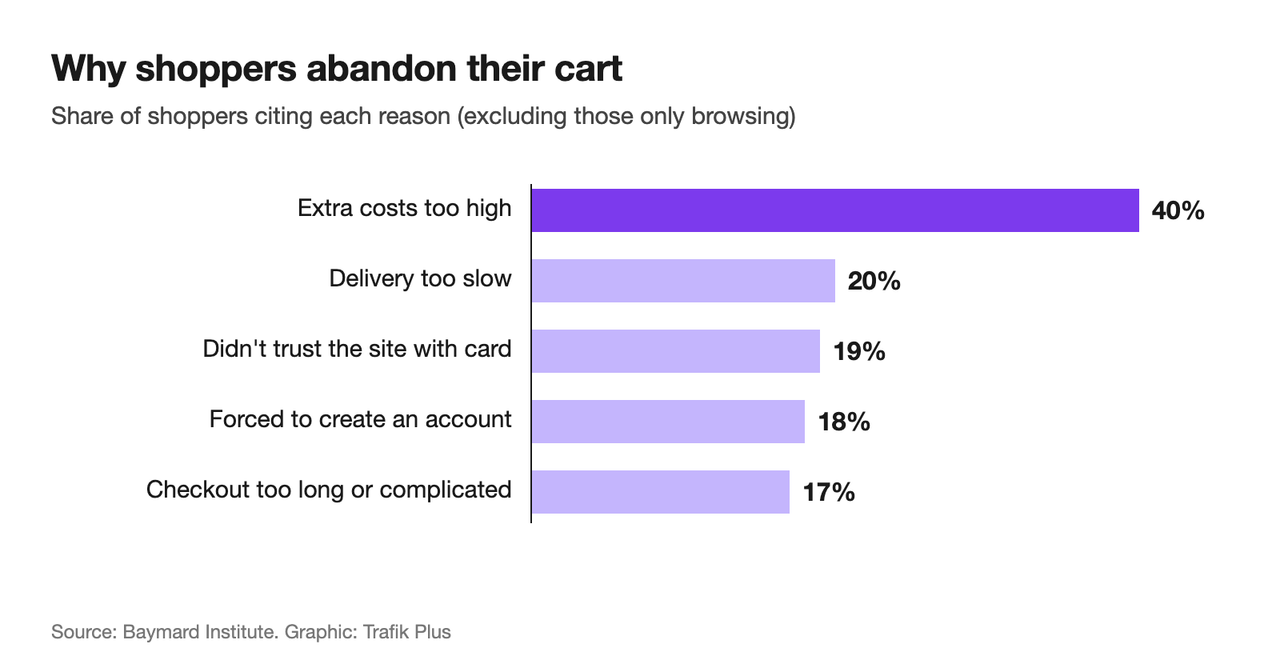
Almost every item on that list is something a CRO agency audits first.
How much does a Shopify CRO agency cost?
Prices depend on the agency, the country and how much work is included. As a reference point, a 2026 comparison of UK CRO agencies(opens in a new tab) listed starting prices from about £1,800 to more than £15,000 per month. The comparison is published by one of the agencies it ranks, so read it as a range rather than a ranking.
Engagement | Typical scope | Starting prices seen in 2026 (UK) |
|---|---|---|
One-off audit or sprint | Research, a prioritized list of fixes, sometimes a first round of changes | From about £2,500 |
Entry retainer | A few tests per month on a small store | From about £1,800 to £5,000 per month |
Mid-market retainer | Research, design, development and testing in one team | About £5,000 to £15,000 per month |
Enterprise retainer | Several tests running at once, dedicated analysts | £15,000 per month and up |
Most retainers ask for a 3 to 6 month minimum, because a testing program needs several cycles to show results. Some agencies also sell a one-off audit, which is a good way to judge their work before committing.
Do you need a Shopify CRO agency?
An agency makes sense when:
- You have steady traffic and sales. A/B tests need volume. A store with a few hundred orders a month can wait weeks for a clear result on a single test.
- You spend a lot on ads. The more you pay per visitor, the more each conversion point is worth.
- Your team has no time or skills for testing. Research, design, theme development and statistics rarely sit in one person.
- Growth has stalled even though traffic keeps coming.
It is too early when your store is new, when traffic is low, or when obvious problems are still visible (a broken mobile menu, no reviews, hidden shipping costs). Fix those yourself first; you don't need a test to know they hurt.
How to choose a Shopify CRO agency
Ask these questions before signing:
- Do you code Shopify themes in-house? Otherwise the agency hands you a slide deck and you still need a developer.
- How do you find what to test? Look for research (analytics, recordings, surveys), not a fixed checklist applied to every store.
- How do you decide a test has won? A serious agency talks about sample size and test length, and doesn't stop a test after three days.
- Can I see case studies from stores like mine? Similar size, similar price range, ideally similar products.
- Who owns the work? The theme code, the test results and the research should stay yours if you leave.
- How do you report? You want revenue and conversion results, not only a list of tasks done.
- What is the minimum term? Know the commitment before you start.
- Do you also look at speed and apps? A CRO agency that only adds apps can make the store slower.
What you can improve before hiring an agency
Many conversion gains don't need a test or an agency. Start with these:
- Show reviews next to the price. Social proof answers the first question of a new visitor. You can display your Trustpilot rating on your theme.
- Keep the add to cart button in reach on mobile with a sticky add to cart bar.
- Show shipping costs early. A free shipping progress bar tells shoppers how far they are from free delivery, and nudges the basket up.
- Help visitors find products with predictive search and collection filters.
- Raise the average order with quantity discounts, build-a-box bundles or complementary products. Letting customers build their own bundle also plays on the IKEA effect.
- Remove the apps you no longer use. Each one can add scripts to every page.
Once those basics are in place and your traffic grows, a CRO agency has a clean base to test from, and its retainer goes to harder problems.
Frequently asked questions
What does CRO stand for?
CRO stands for conversion rate optimization: the work of getting a bigger share of your visitors to buy, sign up or take whatever action you want them to take.
What does a Shopify CRO agency do?
It studies how visitors use your store (analytics, heatmaps, session recordings, surveys), finds where they drop off, changes the theme or apps to fix it, and A/B tests those changes to keep only the ones that raise sales.
How much does a Shopify CRO agency cost?
In a 2026 comparison of UK CRO agencies(opens in a new tab), starting prices ran from about £1,800 to more than £15,000 per month, usually with a 3 to 6 month minimum. One-off audits start at a few thousand.
What is a good conversion rate on Shopify?
According to Littledata(opens in a new tab), the median Shopify store converts 1.4% of sessions. Above 2.7% puts a store in the top 20%, above 3.5% in the top 10%.
How long does CRO take to show results?
Fixing obvious problems (a broken mobile menu, hidden shipping costs) can show up within weeks. A proper A/B test usually needs two to four weeks of traffic, and a CRO program pays off over several months of tests.
Is CRO worth it for a small Shopify store?
Yes, but not always through an agency. With little traffic, A/B tests take too long to give a clear answer. Fix the obvious friction yourself first, and bring in an agency once traffic and revenue justify a monthly retainer.
What is the difference between CRO and SEO?
SEO brings more visitors from search engines. CRO makes more of the visitors you already have buy. The two work together: every visitor SEO brings is worth more on a store that converts well.
Can you A/B test on Shopify without an app?
Yes. Since June 2026(opens in a new tab), Shopify Rollouts(opens in a new tab) lets you A/B test two themes or two checkout setups from Markets > Rollouts in the admin. Testing a single element still often goes through a dedicated app.

Keep reading

SEO vs PPC: Organic vs Paid Search on a Fixed Budget
SEO vs PPC for a Shopify store with a fixed budget: cost per click vs cost per page, click share data, when to move spend, and a worked $3,000 budget split.

Shopify Email Flows: 7 Automations That Earn Without Ad Spend
The seven Shopify email flows that turn traffic you already paid for into revenue: timing, content and setup in Shopify Messaging and Klaviyo, with 2026 benchmarks.

Shopify SEO: The Guide to Free Traffic That Replaces Paid Clicks
Shopify SEO step by step: site structure, collection and product pages, duplicate URLs, admin SEO fields, structured data, Core Web Vitals, blog and Search Console.