Digital Dropshipping: What It Really Is, PLR vs MRR, and How to Start on Shopify

Summarize this article with AI


Digital dropshipping explained: PLR vs MRR rights, whether it is legit, what to check before buying a pack, and how to sell digital products on Shopify.
“Digital dropshipping” is sold as the easy version of dropshipping: no stock, no shipping, no suppliers, 100% margin. Buy a library of ebooks, put them in a store, run a few videos, collect sales on autopilot.
Part of that is true. Digital products really do have near-zero delivery costs. The rest needs a closer look, because the model has little to do with dropshipping, and the “1,000 ready-to-sell products” you buy are the same files thousands of other people bought that week.
Trafik Plus is a Shopify agency. We develop Shopify themes, including our own theme, Pops, and we build stores that sell physical and digital products. For this guide we read the documentation of Shopify's Digital Products app(opens in a new tab), Gumroad, Etsy and Stripe, compared the PLR and MRR libraries sold as “digital dropshipping” kits, and watched two popular tutorials on selling digital products, in November 2026.
Short answer: digital dropshipping means reselling digital products (ebooks, PDFs, templates, courses) that you bought with resale rights, usually PLR or MRR, instead of creating them yourself. It is legal when the licence allows it. It rarely works as-is, because the same files are sold everywhere; it works when you rewrite, rebrand or bundle them into a product that is clearly yours.
What is digital dropshipping?
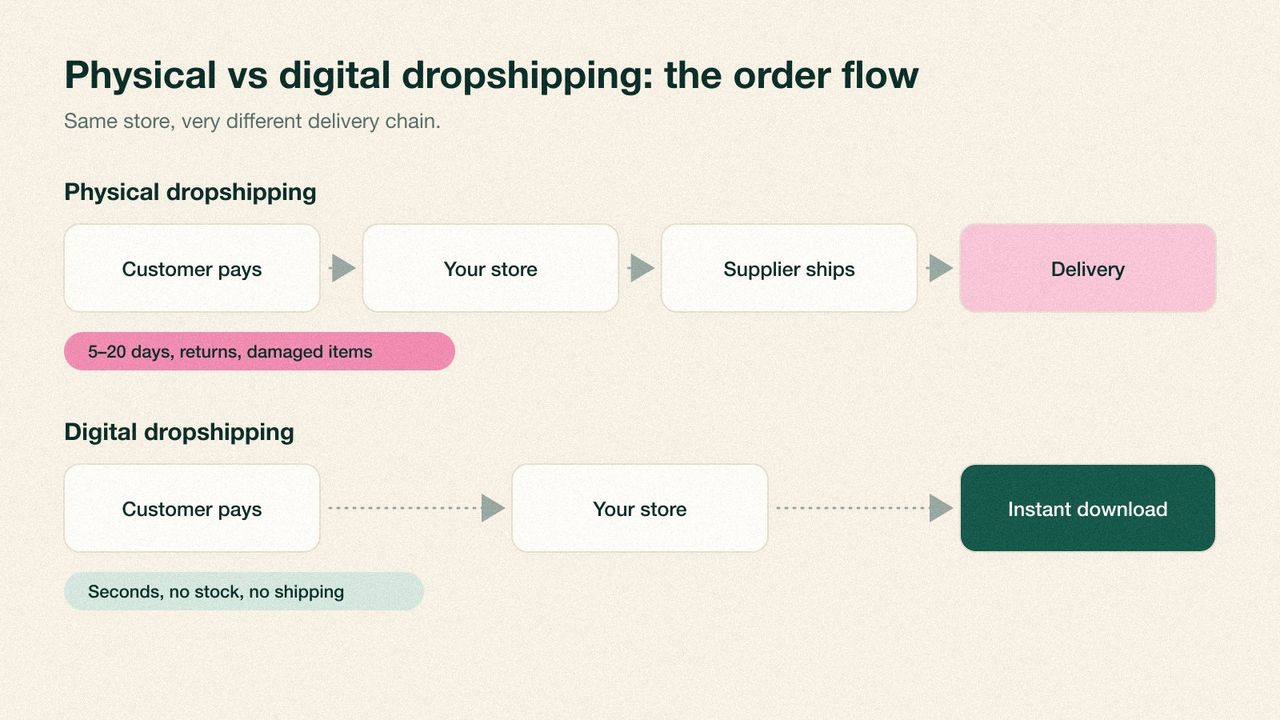
In classic dropshipping, you sell a physical product and a supplier ships it to your customer. In digital dropshipping, there is nothing to ship: you sell a file, and the customer downloads it right after paying.
The “supplier” is the person who sold you the rights to resell that file. You buy a pack once (often a few dozen dollars for hundreds of ebooks), then sell copies as many times as the licence allows. Every sale after the first one is almost pure margin, minus payment and platform fees.
Typical digital dropshipping products:
- Ebooks and guides (fitness, money, self-help, cooking, parenting)
- Printable planners, workbooks and journals
- Canva and Notion templates
- Social media packs: post templates, reels, “faceless” video libraries
- Mini-courses and video trainings
- Prompt packs and AI guides
Why it is not really dropshipping
Dropshipping depends on a supplier who holds stock and ships orders for you. A digital product has no stock and no shipping, so the “drop” part disappears. What is left is resale under licence: you buy the right to sell copies, you sell them, the platform delivers the file.
That matters for two reasons. First, your only real supplier risk is the licence: if it does not allow resale, you are selling someone else's work. Second, the hard part moves from logistics to marketing. With no shipping time and no stock to beat, the only things that make a buyer choose you are the product page, the offer and the trust you build.
PLR, MRR and resell rights: what you are allowed to do
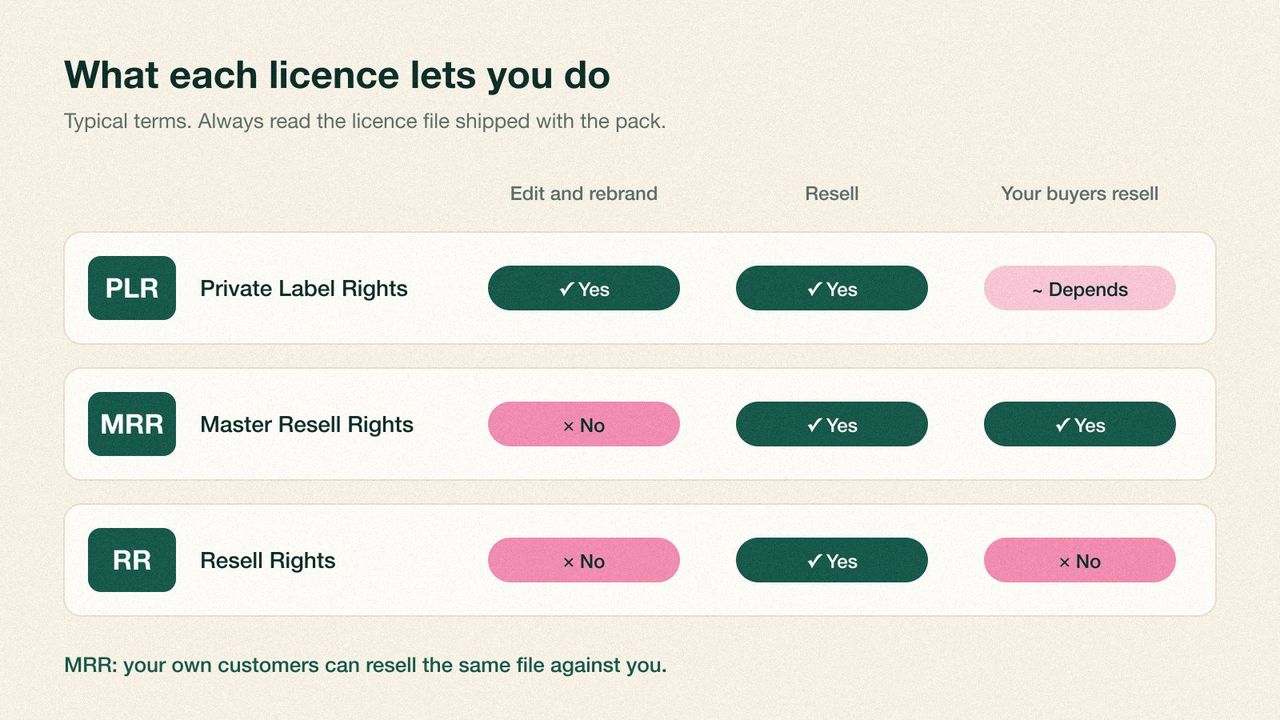
Almost every digital dropshipping pack comes with one of these three licences. Terms change from seller to seller, so always read the licence file shipped with the pack, but the usual rules are these:
Right | PLR (Private Label Rights) | MRR (Master Resell Rights) | RR (Resell Rights) |
|---|---|---|---|
Resell the product | ✅ Yes | ✅ Yes | ✅ Yes |
Edit the content | ✅ Yes, freely | ❌ No, sold as-is | ❌ No, sold as-is |
Put your name or brand on it | ✅ Yes, you can claim authorship | ❌ No | ❌ No |
Your buyers can resell it | Depends on the licence | ✅ Yes | ❌ No, personal use only |
Give it away for free | Often ✅ Yes (lead magnet) | Often ❌ No | ❌ No |
Best use | Raw material to rewrite into your own product | Fast resale, high competition | Simple resale to end users |
PLR is the most useful of the three because you can change everything: title, structure, examples, design, author name. MRR is what most “sell it and keep 100%” packs use, and it creates a chain where your own customers can resell the same file against you, sometimes for less.
Digital dropshipping vs dropshipping
Digital dropshipping | Physical dropshipping | |
|---|---|---|
Startup cost | Low: a product pack and a store | Medium: samples, store, test ads |
Margin per sale | 90–100% before marketing | Often 20–40% before marketing |
Delivery | ✅ Instant download | ❌ 5–20 days from the supplier |
Refund and return risk | Low, with the EU waiver at checkout | High: damaged items, delays, returns |
Product differentiation | ❌ Weak if you resell untouched packs | ❌ Weak if you resell generic products |
Customer trust | Harder: buyers cannot touch the product | Easier once reviews come in |
Main bottleneck | Offer, copy and traffic | Supplier quality and shipping |
The margin is the real advantage. A $30 ebook sold 100 times costs you nothing extra to deliver. The disadvantage is symmetrical: because delivery is free for everyone, the only barrier between you and a thousand competitors is how good, specific and trusted your offer is.
Is digital dropshipping legit?
Yes, reselling digital products is legal when your licence covers it. Whether it is a good business is a different question, and the answer depends on what you do with the files. Four problems come up again and again:
- Everyone has the same files. Packs of 1,000+ ebooks sell for a few dollars. A buyer who searches the exact title of your ebook may find it free or cheaper elsewhere.
- Old, generic content. Many PLR ebooks are a few years old, written to be generic and never fact-checked. Selling them as expert advice hurts refunds, reviews and your brand.
- Platform rules. Etsy's creativity standards(opens in a new tab) require that items be made or designed by the seller, so listing untouched PLR there is risky. Payment providers are also strict: Stripe's restricted businesses list(opens in a new tab) bans get-rich-quick schemes, sites “promising quick and easy gains” and services “with no added value”.
- Income claims. Much of the noise around digital dropshipping comes from people selling the method, not the products. Treat screenshots of revenue as marketing.
The model becomes legit in the full sense when you add value: you rewrite the PLR for a precise audience, fix and update the content, design it properly, add exercises or templates, and sell it under your own brand. At that point it is simply selling digital products, which is a real and well-proven business.
What a typical “1,000 products” library includes
Most digital dropshipping offers look alike: lifetime access to a library of hundreds or thousands of ebooks and templates for a few dozen dollars, often with a rebrand kit (editable covers in PSD or Canva) and a bank of “faceless” short videos to post on social media. The promised method is always the same: pick products, rebrand them, open a store in minutes, post videos or run ads, and sell.
The good part: the entry price is low, a rebrand kit pushes you to put your own brand on the products, and short videos are a sound way to get first traffic.
What to check before buying one:
- The licence: it should state clearly whether the files are PLR, MRR or resell rights, and who the seller is. No licence, no resale.
- The refund policy: many packs are sold with no refunds at all. Know it before you pay.
- The promises: sales “on autopilot” and “100% profit” claims sit badly next to terms that give no guarantee of results.
- The reviews: ratings shown on the sales page itself, without a third-party source, prove little.
- The competition: everyone who buys the same library gets the same files. Without a real rewrite, you compete with all of them on identical products.
Our take: a cheap library can be useful raw material for a first test, as long as you treat it as PLR to rewrite, not as finished products to resell.
What the best tutorials do differently
We watched two popular YouTube guides on the topic: How to Sell AI Digital Products(opens in a new tab) by Nathan Nazareth and How to Make F*ck You Money Selling Digital Products(opens in a new tab) by The Ecom King. Neither recommends reselling a pack as-is. Both create a specific product, and that is the main lesson.
Nathan Nazareth: niche down, start organic
- Pick a niche you know from your own experience, then use Etsy bestsellers for inspiration.
- Make the product very specific. Not “an Instagram guide” but a guide to one format, one result, one timeframe.
- Write the first draft with ChatGPT, then design it with a Canva or Notion template. Add a short video walkthrough to over-deliver.
- Price low-ticket ebooks between about $17 and $150.
- Sell on your own store or a marketplace (Gumroad, Whop, Skool). Get traffic from organic short videos first, then affiliates, and only pay for ads once the product sells.
The Ecom King: validate, bundle, then run ads
- Three mistakes kill digital products: a price that is too low, a vague product name, and no proof (no reviews, no social proof).
- Price for paid traffic. He puts the cost of winning one customer with Meta ads at roughly $25 to $38, so a $19 workbook loses money on every sale.
- Validate demand before you build: revenue of similar products on Etsy over the last 30 days, Google Trends over 12 months, and competitors already running ads.
- Build a main product plus bonuses and sell tiers. In his example: a 62-page printable workbook, then workbook + cards for $22, then the full set for $30.
- Sell on your own Shopify store, not Etsy, and make ads that look like native content rather than ads.
Two caveats. The revenue figures quoted in both videos (millions of dollars of sales, $57,000 in a first month) are shown by the creators and are not independently verified. And both creators earn affiliate commissions on the tools they recommend, including Shopify.
How to start digital dropshipping on Shopify, step by step
1. Choose one audience and one problem
“Fitness ebooks” is not a niche. “A 30-day home workout plan for new mothers” is. The narrower the promise, the easier the product page, the ads and the price.
2. Get a product you have the right to sell
Either buy a PLR pack in your niche and keep the licence file, or create the product yourself with AI and your own expertise. If you buy PLR, check that the licence allows commercial resale, editing and rebranding, and whether you can give parts of it away.
3. Rewrite and rebrand it
This is the step that turns a commodity into a product. Change the title, rewrite the intro and structure, update facts and examples, add worksheets, checklists or templates, and design it consistently. Aim for a product someone could not find by searching its title.
4. Set up the store and the Digital Products app
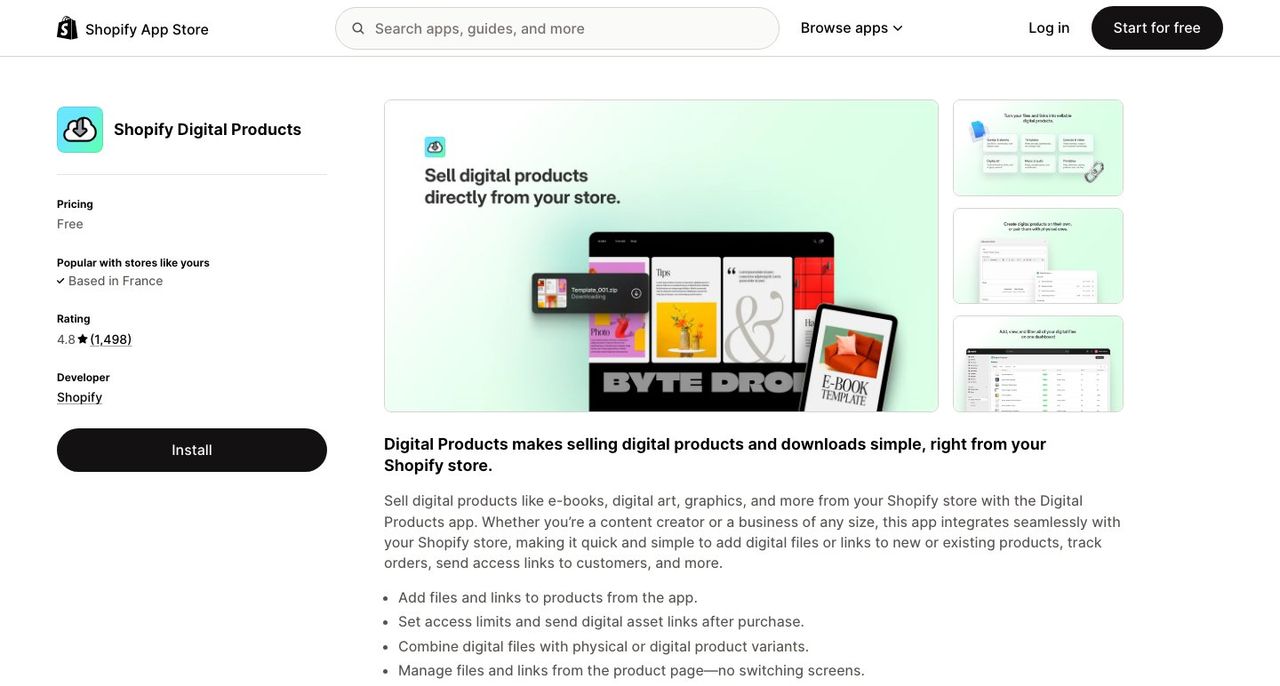
On Shopify, install the free Digital Products app(opens in a new tab) (formerly Digital Downloads). You can attach up to 50 files per variant, up to 5 GB in total, and the customer receives a download link by email after payment. You can also show a “Download now” link on the Thank you and Order status pages, and limit how many times each customer can download the file.
Untick “This is a physical product” in the product shipping settings, so Shopify does not ask for a shipping address. For orders that only contain digital products, set the app to send files automatically: the order is then marked as fulfilled.
If you are testing the idea, Shopify's intro offer keeps the first months cheap: see how the $1 for 3 months offer works.
5. Build a product page that sells something you cannot touch
Buyers cannot hold a digital product, so the page has to show it. Single-offer stores work well here, and our one product Shopify store examples show the patterns that convert. For a digital product, include:
- A precise name that says what it is and who it is for
- Real page previews or a short flip-through video
- The exact contents: number of pages, chapters, templates, formats (PDF, Canva, Notion)
- Who it is not for, which builds trust
- Proof: reviews, results, screenshots from real buyers once you have them
- Instant delivery and file format stated near the add-to-cart button
6. Price above your cost of getting a customer
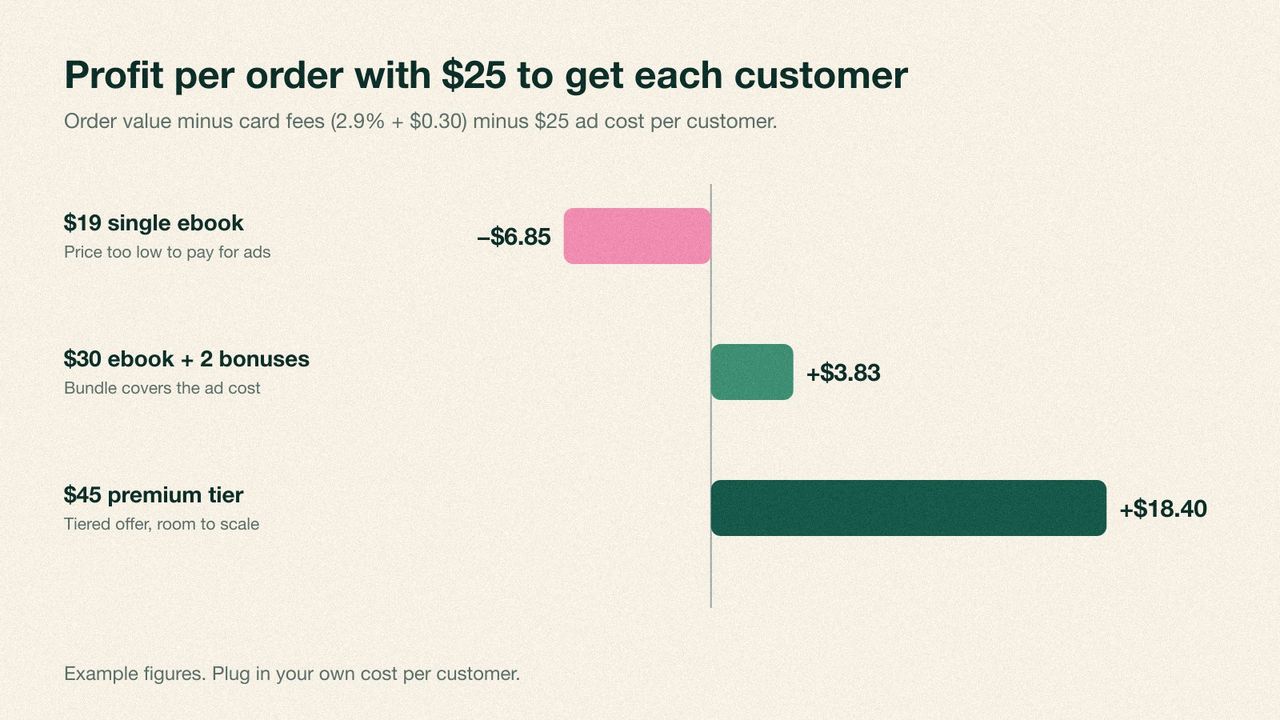
If you plan to run ads, your average order value must cover what a customer costs to acquire. Bundles are the easiest lever: a main product plus one or two bonuses, sold in two or three tiers. On Shopify you can build those packs with a mix and match bundle setup. Then track your conversion rate against benchmarks before you scale spend.
Here is what that means with a cost of $25 to get each customer through ads. A single $19 ebook loses money on every sale, while the same ebook sold as a $30 bundle or a $45 premium tier pays for the ad and leaves a margin:
7. Make the checkout legally safe
In the EU, customers normally have 14 days to withdraw from an online purchase. For digital content, Directive 2011/83/EU(opens in a new tab) (article 16(m)) lets that right end once the download starts, but only if the customer gave prior express consent and acknowledged losing the right. In practice: add a required checkbox at checkout and repeat the waiver in the order confirmation email.
8. Get traffic
Start with what costs time rather than money: short videos showing the product and the problem it solves, an email list with a free sample, and SEO articles on the questions your buyers ask. Move to paid ads once a few organic sales prove the offer, and improve the store side first: our guide to increasing ROAS from your store covers the levers that matter most.
Where to sell digital products: Shopify, Gumroad or Etsy
Shopify | Gumroad | Etsy | |
|---|---|---|---|
Monthly cost | Paid plan, intro offer available | ✅ None | ✅ None |
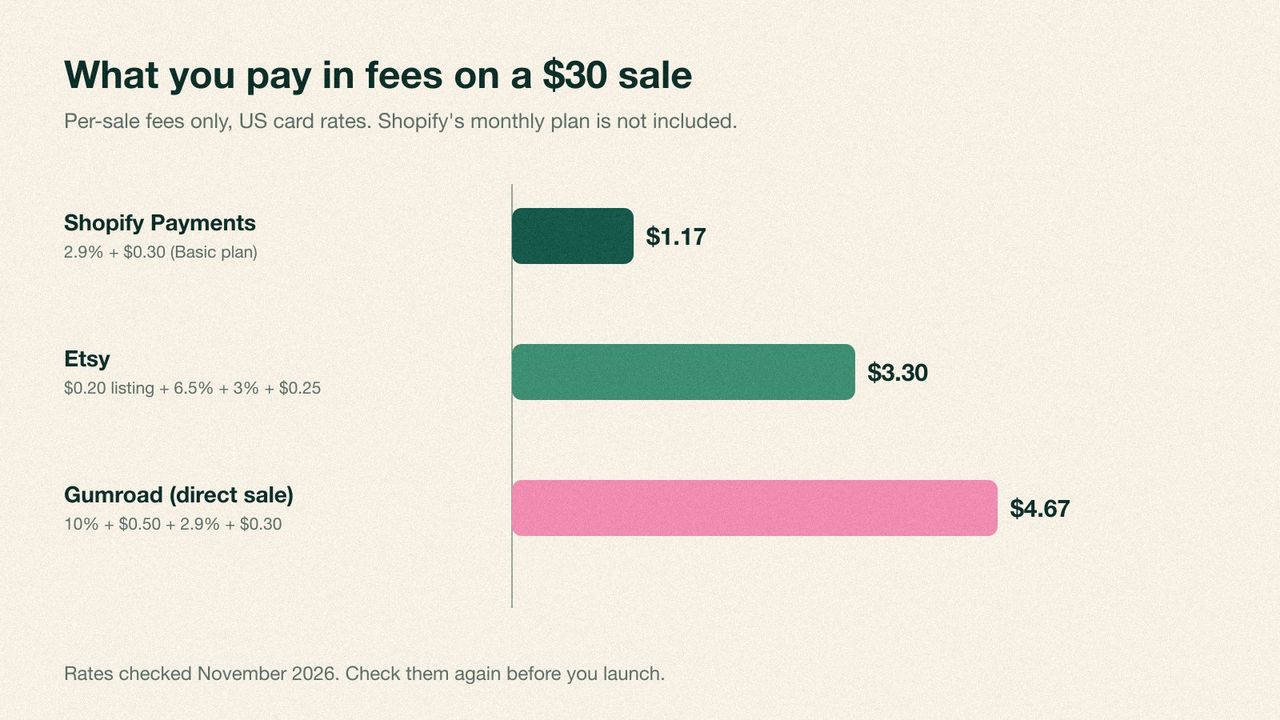
Fees per sale | Payment processing only with Shopify Payments | 10% + $0.50, plus card processing | $0.20 listing + 6.5% transaction + processing |
Your own brand and domain | ✅ Yes | Partial: Gumroad profile | ❌ No, Etsy shop page |
Built-in marketplace traffic | ❌ No, you bring traffic | Some, via Discover (30% fee) | ✅ Yes, but very competitive |
Customer emails and data | ✅ Yes | ✅ Yes | ❌ Limited |
Untouched PLR resale | Allowed if your licence allows it | Allowed if your licence allows it | ❌ No, items must be made or designed by you |
Best for | A brand with bundles, upsells and ads | Testing a first product fast | Original printables with search demand |
Sources: Gumroad pricing(opens in a new tab), Etsy fees(opens in a new tab) and Shopify's help center. Fees checked in November 2026; check them again before you launch.
Legal and tax checklist
- Licence proof: keep the licence file and the receipt for every PLR or MRR pack you resell.
- Withdrawal waiver (EU): required checkbox at checkout, confirmed in the order email.
- VAT on digital products (EU): VAT is charged at the customer's country rate. Above €10,000 of cross-border B2C sales in the EU per year, register for the One-Stop Shop (OSS)(opens in a new tab) instead of registering in each country.
- No income promises: if you sell money-making products, do not promise results you cannot prove. Payment providers can close accounts over it.
- AI-generated content: in the US, purely AI-generated material is not protected by copyright, according to the US Copyright Office(opens in a new tab). Your own edits, structure and design make the product more defensible.
The better version: own the product
Digital dropshipping in its pure form, buying a big pack and reselling untouched files, puts you in the most crowded corner of the market with nothing to stand out. The version that works looks much more like a small brand: one audience, one clear problem, a product built or rewritten for them, a page that shows exactly what they get, and traffic you can repeat.
Use PLR as a draft, AI as an assistant, and your own experience as the part nobody else can copy. That is what turns a file into a product people trust and buy again.
FAQ
What is digital dropshipping?
It is reselling digital products such as ebooks, templates or courses that you bought with resale rights (PLR, MRR or resell rights). The customer downloads the file instantly, so there is no stock and no shipping.
Is digital dropshipping legit?
Yes, as long as your licence allows resale. It becomes a solid business when you rewrite or rebrand the products. Reselling untouched packs is legal but hard, because thousands of sellers have the same files.
What is the difference between digital dropshipping and dropshipping?
Dropshipping sells physical products shipped by a supplier. Digital dropshipping sells files delivered by download. Margins are much higher with digital products, but differentiation and trust are harder.
Is digital dropshipping profitable?
It can be, because each extra sale costs almost nothing to deliver. Profit depends on your price, your cost of getting a customer and refunds. A product priced below your cost per customer loses money even with a 100% margin.
What is the difference between PLR and MRR?
PLR lets you edit the product and sell it under your own name. MRR lets you resell it as-is and lets your buyers resell it too. PLR is better raw material to build your own product.
Can I sell PLR ebooks on Shopify?
Yes. Install Shopify's free Digital Products app, attach the file to a product and Shopify emails a download link after payment. Check first that your licence allows commercial resale.
Can I sell PLR products on Etsy?
Etsy requires items to be made or designed by the seller. Untouched PLR does not meet that rule, so sell only products you have substantially created or redesigned.
What are the best digital products to sell?
Products that solve one specific problem for one audience: printable workbooks and planners, niche ebooks, Canva or Notion templates, and short courses. Check demand first with marketplace bestsellers, Google Trends and competitors already running ads.
Do I need to charge VAT on digital products?
In the EU, yes: VAT is due at the customer's country rate. Above €10,000 of cross-border B2C sales a year, use the One-Stop Shop (OSS) to declare it. Outside the EU, rules depend on your country and your buyers' location.

Keep reading

How to Remove “Powered by Shopify” From Your Store: 3 Methods (Horizon, Dawn, Pops)
Remove “Powered by Shopify” from your footer in 2 minutes: a checkbox, theme content or Liquid code. Methods checked on Horizon, Dawn and Pops.

Shopify Academy Is Closed: What Happens to Certifications and Where to Learn Shopify Now
Shopify Academy shut down on October 29, 2026. What happens to refunds, badges and Partner tiers, how partners reacted, and where merchants and developers learn Shopify now.

8Lab Review: Price, Content and Whether Alex Shane's E-commerce Course Is Worth It
8Lab (8lab Ecosystem): the €990 Starter plan, INCUBEIGHT, course content, Discord and logistics. Our honest review of Alex Shane's e-commerce program.