
Bundle Pricing: How to Price a Bundle Without Losing Margin

Summarize this article with AI


How to price a bundle with real margin math: the price floor formula, discount depth by margin, cannibalization break-even, volume tiers and mix-and-match rules.
Bundle pricing means selling two or more products together for one price, usually lower than the sum of their individual prices. The right bundle price is not "10 to 20% off". It is the price that earns more gross profit per order than the order the shopper would have placed without the bundle, after product cost and shipping.
This guide gives you the margin math to find that price: the price floor formula, how deep a discount your margins can afford, when a bundle cannibalizes sales you already had, and how to price volume tiers and mix-and-match boxes. Every example shows the arithmetic, so you can rerun it with your own numbers.
What is bundle pricing?
Bundle pricing (also called price bundling) is a pricing strategy where you sell a set of products as a package at a single price. In ecommerce that is usually a discount on the combined list price: a skincare routine, a "buy 3, save 15%" offer, or a build-your-own box.
Marketing researchers Stremersch and Tellis(opens in a new tab) separate two ideas that often get mixed up. Price bundling sells separate products together at a discount without changing them. Product bundling integrates the products into something that is worth more as a set, at any price. Most Shopify bundles are price bundles, which is why the discount and the margin math matter so much.
If you need the basics first (bundle types, kits vs multipacks, examples), read what bundles are in ecommerce. This article picks up where its pricing section stops.
Pure vs mixed bundling: which one to use
There are two ways to offer a bundle:
- Pure bundling: the products are only sold together. You can't buy the parts on their own.
- Mixed bundling: the products are sold on their own and as a bundle, and the shopper chooses.
Economists have studied this since Adams and Yellen (1976)(opens in a new tab), who framed bundling as a way to charge different shoppers different prices without asking who they are. Later work by McAfee, McMillan and Whinston(opens in a new tab) showed that mixed bundling will almost always strictly increase a seller's profits(opens in a new tab) compared with selling the items separately, even when the way shoppers value each product is unrelated. Schmalensee(opens in a new tab) explained why: a bundle reduces the spread in what buyers are willing to pay, so one price fits more of them.
For a Shopify store the practical conclusion is simple: default to mixed bundling. Keep every product buyable on its own and add the bundle as a better-value option next to it. Shoppers who only want one item still buy, and the ones willing to spend more take the bundle.
Pure bundling only makes sense when a part is useless alone (a refill that only fits your device) or when you don't want to sell an item separately at all (a limited gift set).
The bundle price floor formula
Before you pick a discount, work out the lowest price at which the bundle still beats the order it replaces.
Bundle price floor = cost of all items in the bundle + fulfillment cost per order + gross profit of the order the shopper would otherwise place
Here is a worked example. A skincare store sells three products:
Product | Price | Product cost | Gross margin |
|---|---|---|---|
Cleanser | $24 | $6 | 75% |
Serum | $38 | $9 | 76% |
Moisturizer | $32 | $8 | 75% |
Total | $94 | $23 | 75.5% |
Most shoppers who land on the serum buy only the serum. Shipping and packing cost the store $8 per order. So a serum-only order earns $38 − $9 − $8 = $21 of gross profit.
The bundle floor is $23 (cost of the three items) + $8 (one shipment) + $21 (what the serum-only order earned) = $52. Any bundle price above $52 earns more per order than a serum-only sale. That is a discount of up to 44.7% on the $94 list price (1 − 52 ÷ 94).
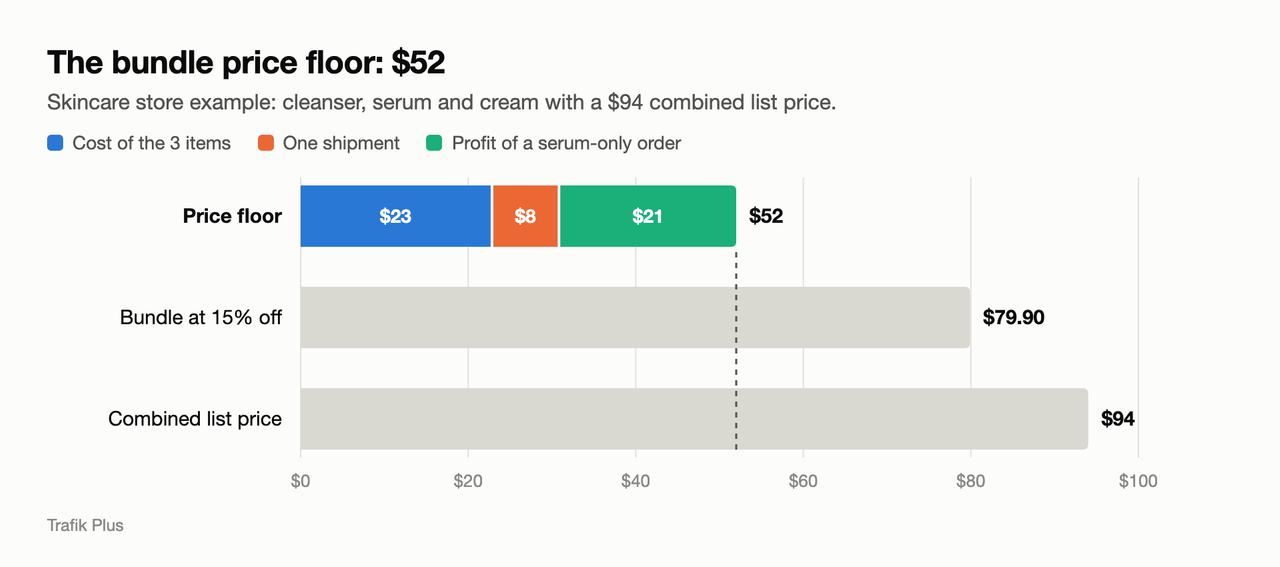
You won't price anywhere near the floor. But it shows how much room you really have, and it shows something the "10 to 20% off" rule ignores: a bundle ships once. Three separate orders would have cost $24 in shipping and packing. The bundle costs $8. That $16 difference can pay for most of the discount.
Cannibalization: the break-even test
The floor assumes every bundle buyer would otherwise have bought only the serum. Some would have bought all three products at full price anyway. For them, the bundle discount is pure lost margin.
Take a 15% bundle discount, so $94 × 0.85 = $79.90.
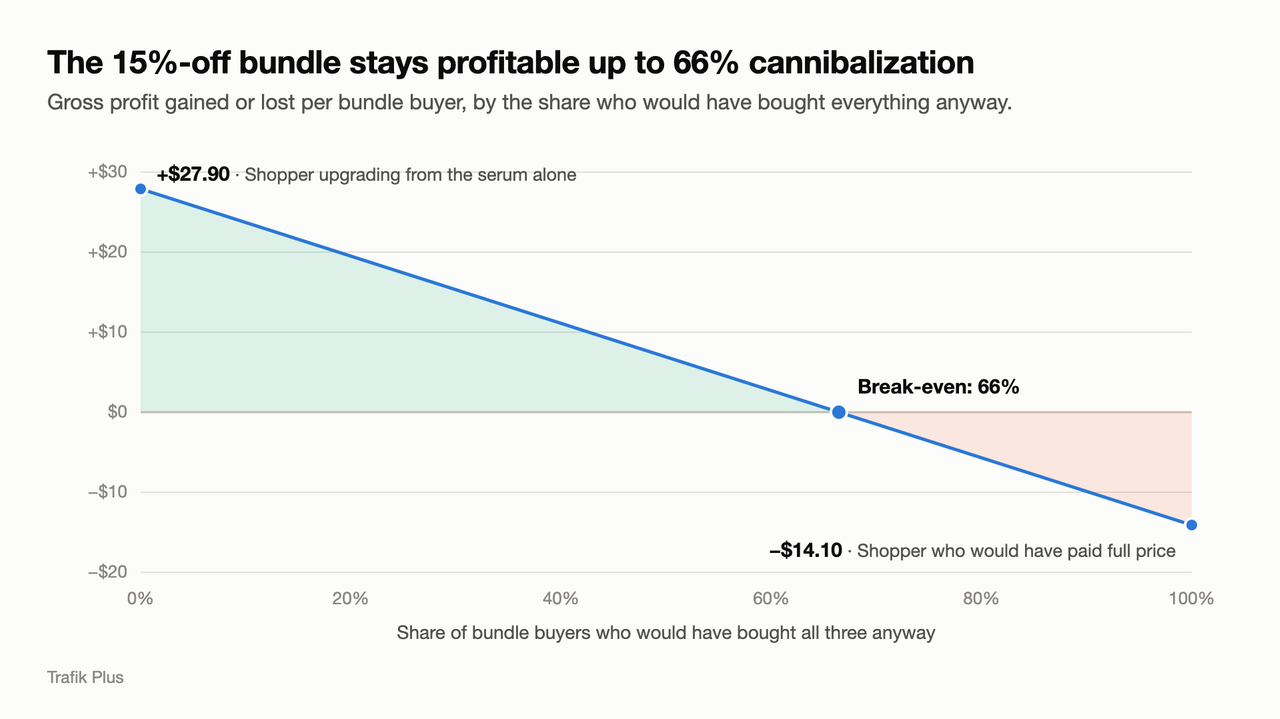
- A shopper who upgrades from the serum alone: $79.90 − $23 − $8 = $48.90 of gross profit, versus $21. You gain $27.90.
- A shopper who would have bought all three anyway in one order: $94 − $23 − $8 = $63 at full price, versus $48.90 with the bundle. You lose $14.10.
The bundle breaks even when the gains equal the losses. If p is the share of bundle buyers who would have bought everything anyway:
$27.90 × (1 − p) = $14.10 × p, so p = 27.90 ÷ 42 = 66%
In other words, the 15% bundle is profitable as long as fewer than two in three bundle buyers would have bought the full set without it. To check where you stand, look at your past orders in Analytics > Reports and count how many orders already contained all the bundle items before the bundle existed. If that share is high, put a cheaper or different product in the bundle, or lower the discount.
How much discount to give on a bundle
The discount you can afford depends on your margin. When you cut the price, each sale keeps less profit, so you need more sales to earn the same gross profit dollars. With a product margin m and a discount d:
- new margin = (m − d) ÷ (1 − d)
- sales lift needed to keep the same gross profit = m ÷ (m − d)
Product margin | 10% off | 15% off | 20% off |
|---|---|---|---|
40% | 33.3% margin, +33% sales needed | 29.4% margin, +60% sales needed | 25% margin, +100% sales needed |
60% | 55.6% margin, +20% sales needed | 52.9% margin, +33% sales needed | 50% margin, +50% sales needed |
75% | 72.2% margin, +15% sales needed | 70.6% margin, +25% sales needed | 68.75% margin, +36% sales needed |
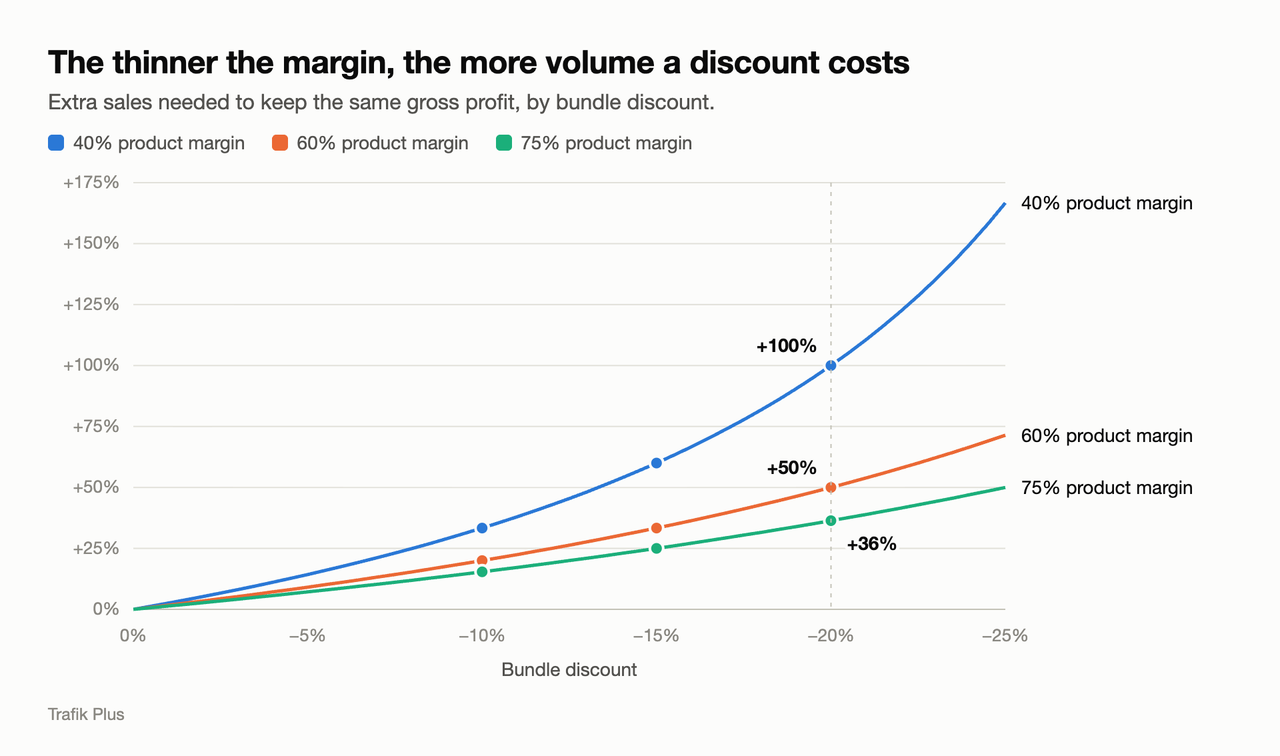
Two things stand out. At a 40% margin, a 20% bundle discount needs twice the sales just to stand still, so a low-margin store should stay around 10% or use a free gift (see below). At a 75% margin, which is common in beauty and supplements, even 20% off needs only 36% more volume, and the bundle is mostly moving shoppers from one item to three.
The table leaves out shipping on purpose. Because a bundle ships once, the real picture is usually better than this table, especially when the alternative is several small orders.
Rules that hold across stores
- Start at 10 to 15% and test upward. Going deeper only pays if the extra conversions cover the table above.
- Show the saving in dollars and percent. In a study of how buyers read bundle prices, Yadav and Monroe(opens in a new tab) found that the perceived deal combines two parts: savings on the items themselves and the extra saving for buying the bundle. Show both, with the compare-at price struck through.
- Put the discount where it counts. Janiszewski and Cunha(opens in a new tab) found that a bundle discount works better when it is assigned to the product that weighs most in the shopper's decision. "Get the moisturizer 40% off with the serum" can beat "15% off the set", even at the same dollar saving.
- Leave your hero product near full price. Discount the add-on, not the item people already come for.
Pricing volume tiers (quantity breaks)
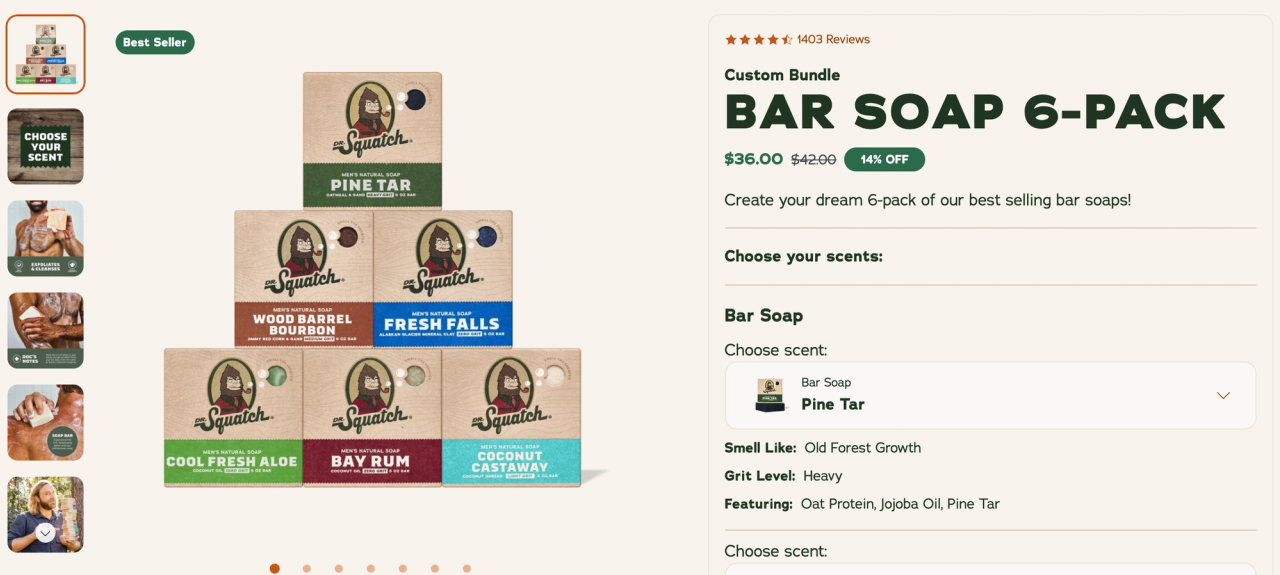
Quantity breaks are a bundle of one product: "buy 2, save 10%; buy 3, save 15%". They suit consumables like coffee, supplements or socks. Here is a worked example with a $30 product that costs $9 to make (70% margin) and $7 to ship per order:
Tier | Order price | Product cost | Shipping | Gross profit per order | Per unit |
|---|---|---|---|---|---|
1 unit, full price | $30 | $9 | $7 | $14 | $14.00 |
2 units, 10% off | $54 | $18 | $7 | $29 | $14.50 |
3 units, 15% off | $76.50 | $27 | $7 | $42.50 | $14.17 |
4 units, 20% off | $96 | $36 | $7 | $53 | $13.25 |
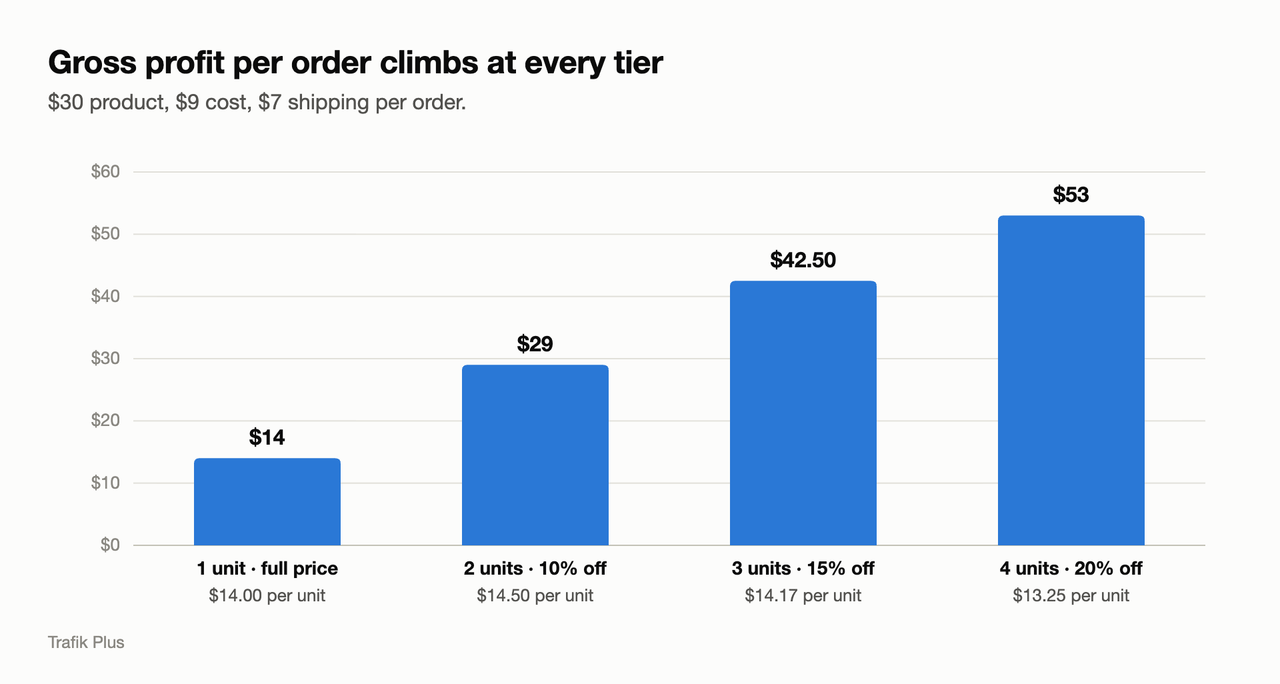
Gross profit per order climbs at every tier, from $14 to $53, while profit per unit barely moves. The shipping saved on extra units pays for most of the discount. That is why tiers work so well in categories where people buy again anyway.
Three pricing rules for tiers:
- Make the step you want the biggest. If you want most buyers on 3 units, make the jump from 2 to 3 feel worth it, and label that tier "Most popular".
- Keep 3 or 4 tiers. More options slow the decision without adding much revenue.
- Check your shipping weights. If 4 units moves the parcel into a heavier rate, rerun the math with the real cost.
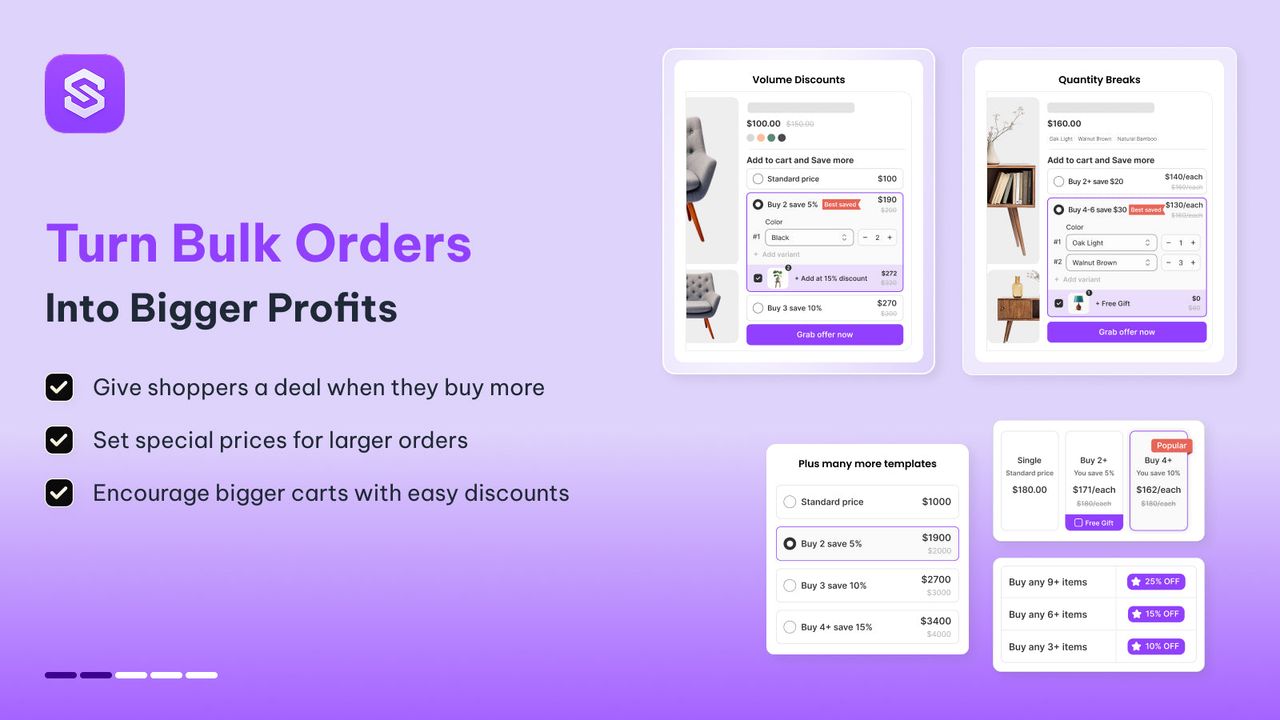
On Shopify you can build tiers with native automatic discounts: one "Amount off products" discount per tier with a minimum quantity. When several discounts can't combine, Shopify applies the best discount for the cart(opens in a new tab), so the highest qualifying tier wins. What native discounts don't do is show the tiers on the product page, which is where the shopper decides. That is the gap a volume discount block fills; this comparison of volume discount apps covers the options.
Pricing mix-and-match bundles
Mix-and-match ("any 3 for $X") is where bundle pricing breaks most often, because the shopper chooses the items, and the items don't cost the same.
Say a candle store prices "any 3 candles for $60", with candles from $18 to $32:
- Three $32 candles are worth $96. At $60, the shopper gets 37.5% off.
- Three $18 candles are worth $54. At $60, the bundle is more expensive than buying them separately, so nobody picks it.
The fixed price is too generous for some baskets and pointless for others. Two ways to fix it:
- Narrow the price band. Limit the pool to candles priced $28 to $32. Three of them are worth $84 to $96, so a $75 box is 10.7% to 21.9% off. Every combination is a real deal, and your worst case is known.
- Use a percentage instead of a fixed price. "Any 3, save 15%" keeps the discount the same whatever the shopper picks. It is less punchy in an ad, but your margin stays predictable.
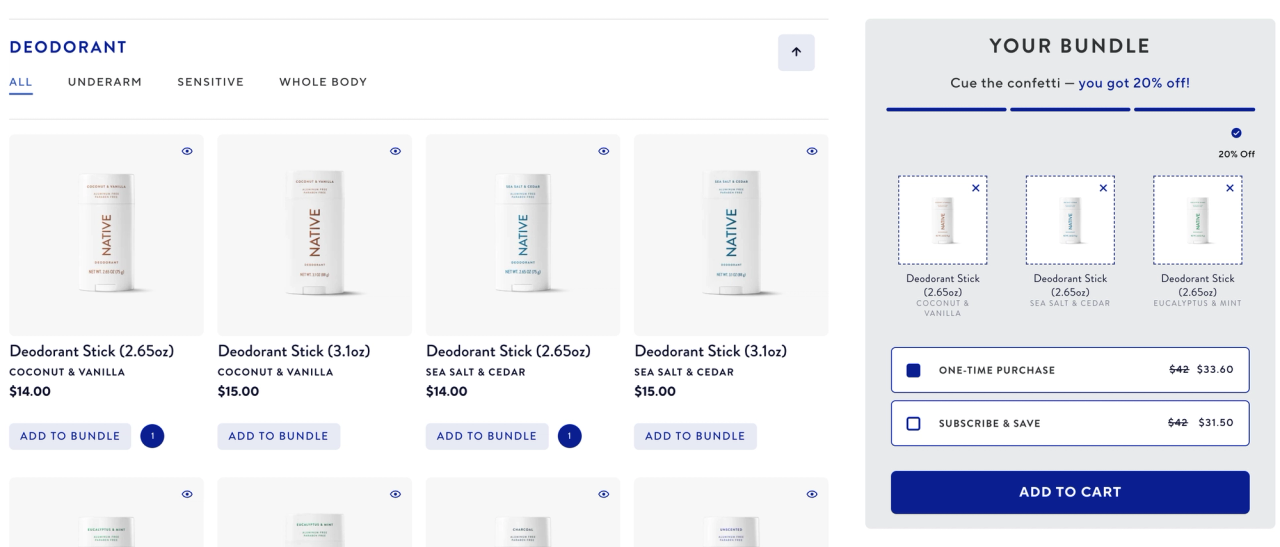
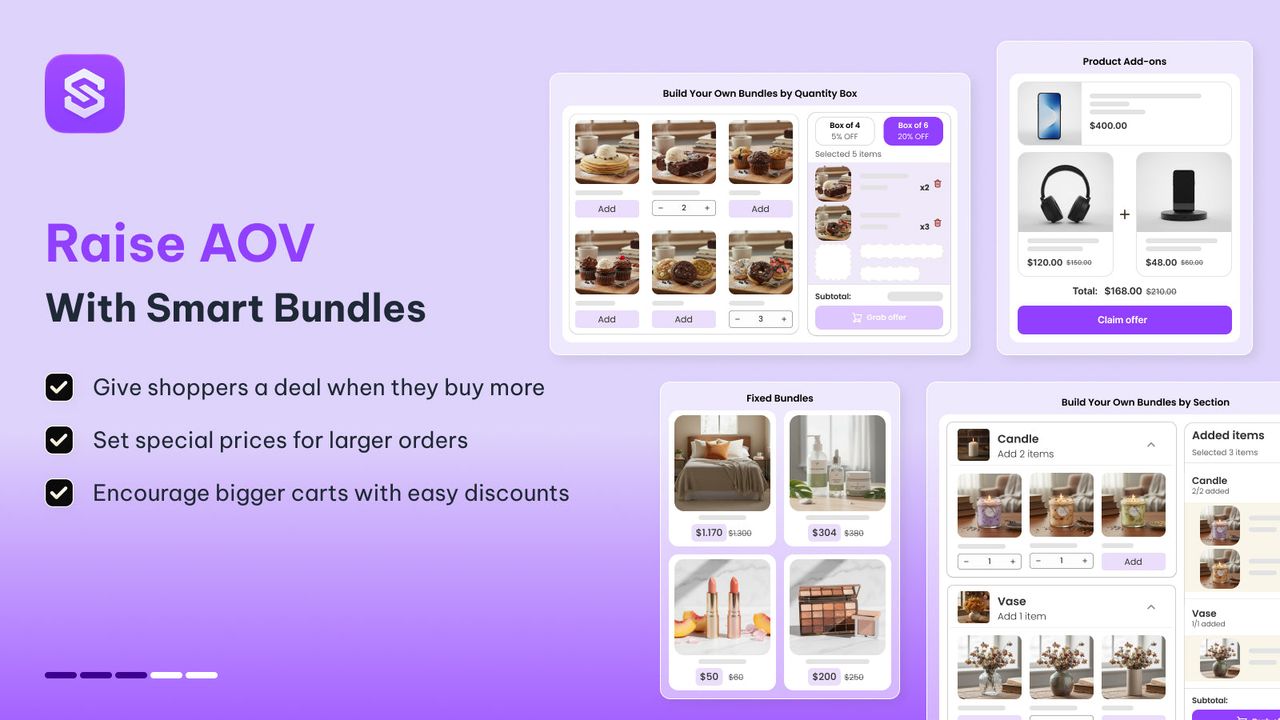
For build-a-box offers ("box of 4, 5% off; box of 6, 20% off"), apply the tier logic above: the bigger box gets the bigger discount, and you check the margin on the most expensive possible box. A mix-and-match block or a build-a-box section lets you set those rules per collection.
Free gift or discount?
A discount costs you its full face value. A free gift costs you its product cost, while the shopper sees its retail value.
Back to the skincare store: a $20 lip balm that costs $5 to make. "Spend $80, get a free lip balm ($20 value)" gives the shopper a $20 saving that costs you $5. A $20 discount on the same order costs you $20.
That makes gifts the better tool for low-margin stores and for tiers: a free gift on a quantity tier lets you keep the discount small and still give the top tier a clear reason to exist. Pick gifts people actually want; a gift nobody values is just a cost.
Shopify details that change your bundle price
- Discount stacking. If your bundle discount can combine with a 15% welcome code, a 15% bundle becomes 1 − 0.85 × 0.85 = 27.75% off. On the skincare bundle that is $67.92 instead of $79.90, and gross profit drops from $48.90 to $36.92. Check the combination settings on every automatic discount and code. Shopify's combination rules(opens in a new tab) also limit stores to 25 active automatic discounts, app discounts included.
- Bundle prices don't follow component prices. With the free Shopify Bundles app, the bundle price is set by hand, and it doesn't update when a component's price changes(opens in a new tab). Raise the serum price and the bundle quietly becomes a bigger discount. Review bundle prices whenever you change prices.
- Discounts are split across components. Shopify Bundles applies a discount to the bundle first, then splits it across the items by price weight. A product that makes up 80% of the bundle price takes 80% of the discount, which affects your per-product margin reports.
If you're choosing a tool to run all of this, our comparison of Shopify bundle apps covers pricing and features. Snap Bundle(opens in a new tab) handles fixed bundles, volume tiers, mix and match, build-a-box and tiered free gifts in one app. It is free while bundle revenue stays under $500 a month, then $12.99 a month with no order cap.
How to test your bundle price
- Set the floor and the break-even share with the formulas above, using your real product costs and shipping.
- Launch at a modest discount (10 to 15%) as a mixed bundle on your best-selling product page.
- Run it for at least two full weeks, or until you have a few hundred orders, so weekly swings even out.
- Measure gross profit per visitor, not conversion rate alone. A deeper discount almost always lifts conversions; the question is whether it lifts profit.
- Move one step at a time (for example 15% to 20%) and compare again.
Bundle pricing is one of the few ways to raise order value from traffic you already pay for. Start from the floor formula, keep the bundle mixed, and let shipping savings and free gifts carry part of the discount. When you're ready to put tiers or boxes on your product pages, Snap Bundle(opens in a new tab) lets you test them without paying until bundles bring in revenue.
FAQ
What is an example of bundle pricing?
A skincare store sells a cleanser ($24), serum ($38) and moisturizer ($32) separately for $94, or as a routine for $79.90 (15% off). The products cost $23 and one shipment costs $8, so the bundle earns $48.90 of gross profit versus $21 for a serum-only order.
How much should you discount a bundle?
Most stores start at 10 to 15% off the combined price. Go deeper only if your margins allow it: at a 40% product margin, a 20% discount needs twice the sales to earn the same gross profit; at 75%, it needs about 36% more.
What is the formula for bundle pricing?
Bundle price floor = cost of all items + fulfillment cost per order + gross profit of the order the shopper would otherwise place. Any price above the floor earns more per order than the alternative.
What is the difference between pure and mixed bundling?
Pure bundling sells products only as a set. Mixed bundling sells them on their own and as a set, so the shopper chooses. Research on bundling shows mixed bundling almost always beats selling items separately, which is why most online stores use it.
What are the advantages and disadvantages of bundle pricing?
Bundles raise order value, ship once and move shoppers from one product to several. The risks are discounting orders you would have got anyway, stacking with other codes, and bundle prices that drift when component prices change.
Can you do bundle pricing on Shopify without an app?
Partly. Native automatic discounts with a minimum quantity can create tiers, and the free Shopify Bundles app creates fixed bundles and multipacks. Showing tiers on the product page, mix-and-match boxes or tiered free gifts needs a bundle app.

Keep reading

Average Order Value: Formula, Calculation Examples and 12 Ways to Increase It
Average order value is revenue divided by orders. The formula with worked examples, where Shopify shows AOV, and 12 ways to raise it, from tiered discounts to post-purchase upsells.

Break-Even ROAS: Formula, Calculator and How to Lower It
Break-even ROAS is 1 ÷ your contribution margin. The formula, which costs to include, how to set it in Google, Meta, TikTok and Pinterest Ads, and how bundles lower it.

16 Best Kombucha Shopify Store Examples (Desktop + Mobile)
16 real kombucha brands on Shopify, from Kyo and Health-Ade to GT's and Remedy: home pages, product pages, pack pickers and subscriptions on desktop and mobile, with the theme each store uses.