
Trendtrack Review: Complete Guide (2026)

Summarize this article with AI


Trendtrack in 2026: features, pricing from $34 to $111/month, user reviews, limits and alternatives, to decide whether the tool is worth its price.
Trendtrack is an e-commerce monitoring tool: it indexes online stores, tracks their ads and email campaigns, and estimates their traffic. It launched in April 2025 and is aimed at dropshippers, media buyers and brands that want to know what their competitors are doing.
Trendtrack is a bootstrapped SaaS, meaning it is funded without outside investment, and it is growing fast: its co-founder and CEO Vincent Alonzi says on X(opens in a new tab) that the tool went from $39,612 in monthly recurring revenue (MRR) at the end of April 2025 to $810,642 on September 16, 2026, while staying bootstrapped.
We are Trafik Plus, an agency that builds Shopify themes and apps. We have no contract with Trendtrack, no affiliate link, and we don't offer a promo code. The information in this article comes from the official pricing page, French comparison articles and user posts on X, all checked in October 2026. Prices and limits change: check the Trendtrack pricing page(opens in a new tab) before you buy.
Trendtrack at a glance
- What it's for: spotting stores that are taking off, analyzing their ads and spying on their emails.
- Price: from $34 to $111 per month on annual billing, plus a custom-quote plan.
- Strength: a French-language interface and data focused on the European market.
- Weakness: no clear free trial, and search quotas that limit the smaller plans.
- Who it's for: sellers who do competitive research every week. For a one-off search, it isn't worth the money.
What is Trendtrack used for?
Trendtrack bundles several tools that used to be paid for separately. French comparison articles describe it as a mix of ad spy tool, traffic estimator and email tracker in a single dashboard.
Shops: find stores that are growing
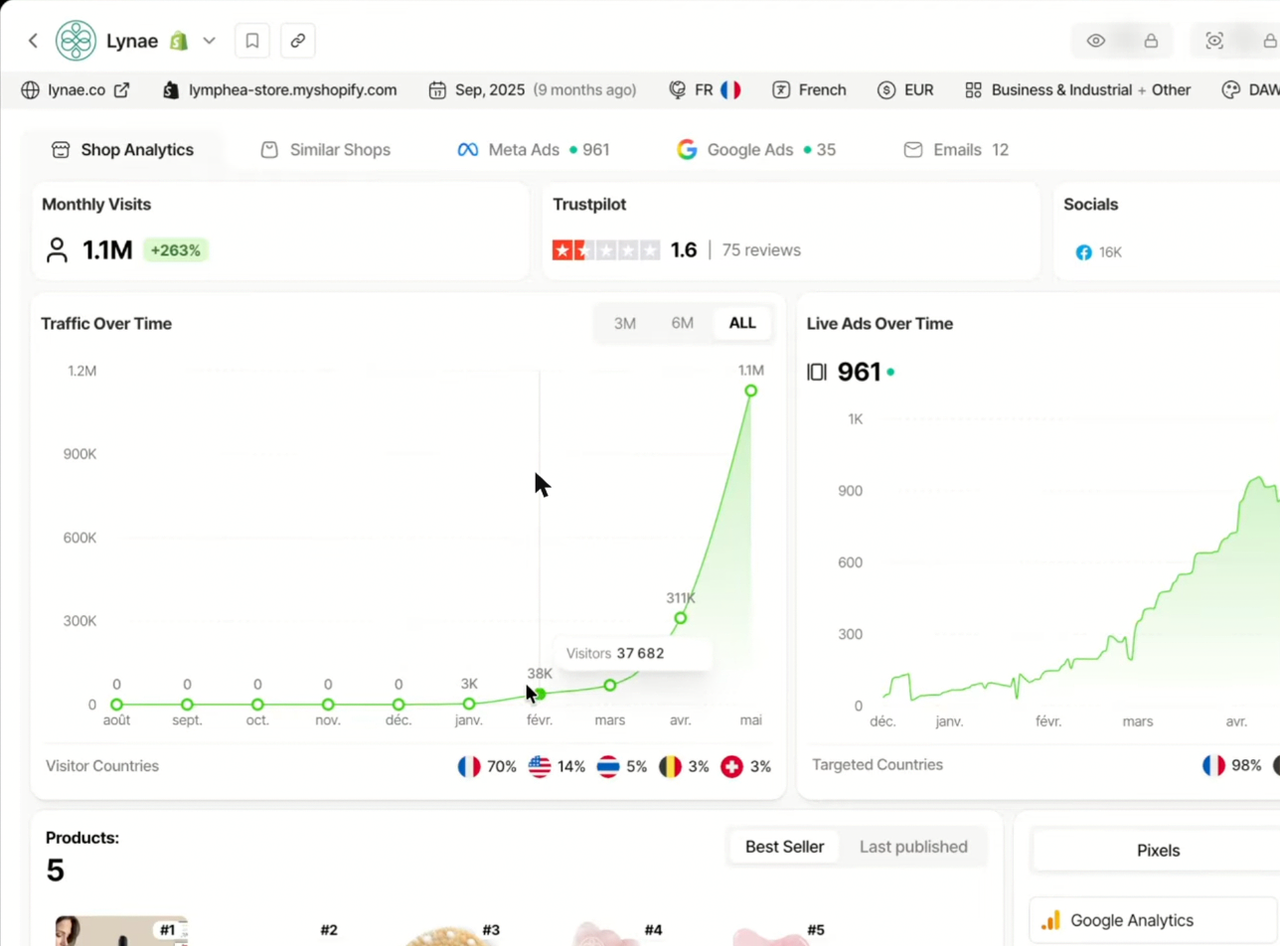
The store library indexes more than a million sites, according to the comparison articles we read. You filter by niche, country or traffic, and you see how a store evolves over time. It is the feature users mention most: on X, sellers share stores found with Trendtrack whose traffic goes from zero to tens of thousands of visits in a few months, along with their number of active ads.
Ads: see which ads are running
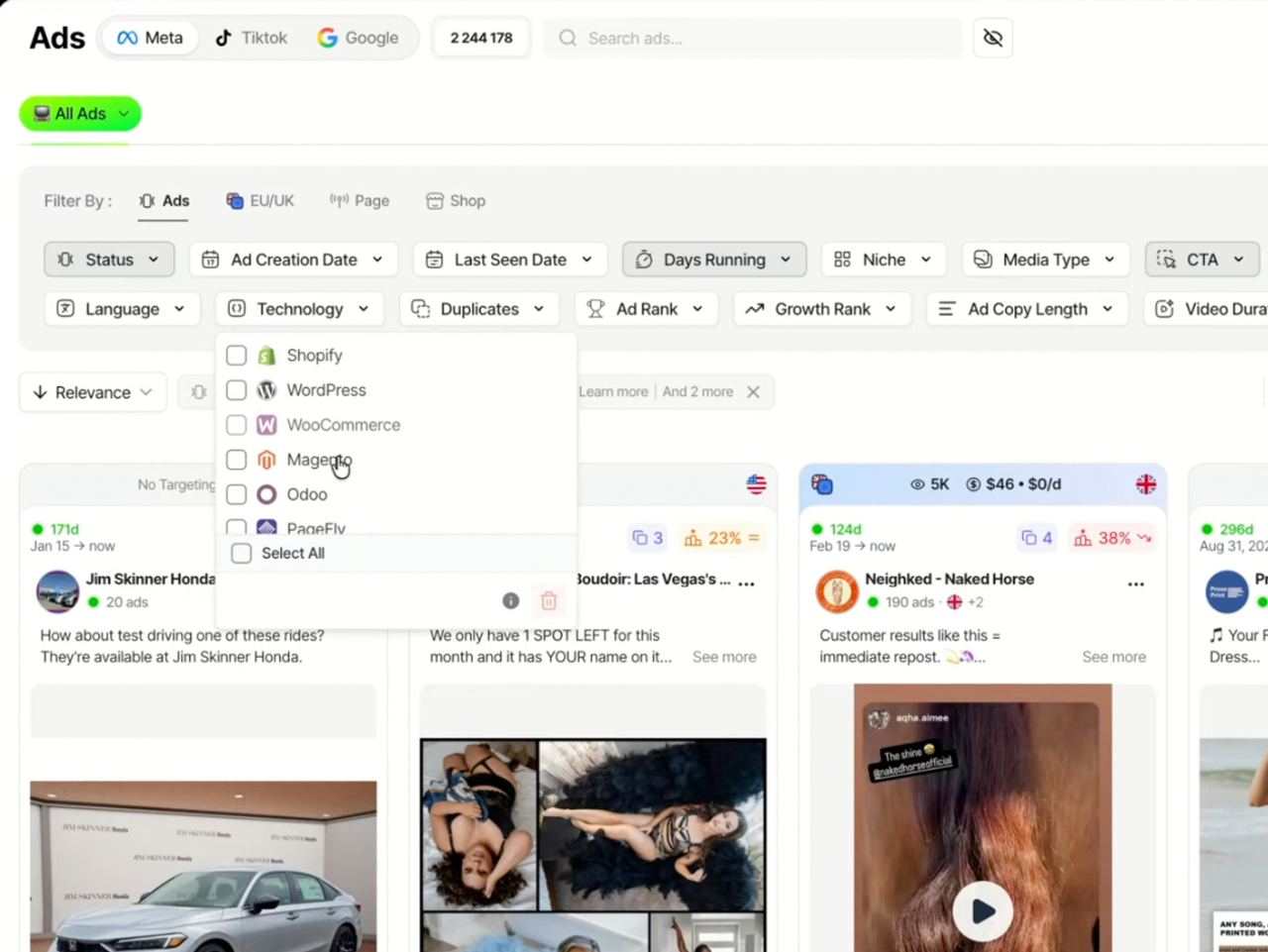
The ad library shows a brand's creatives and, for Europe and the United Kingdom, reach and spend data taken from Meta's ad transparency. One user on X explains that the trend curve in the ranking helps them spot new big advertisers, and therefore new formats that work.
Mail: study your competitors' emails
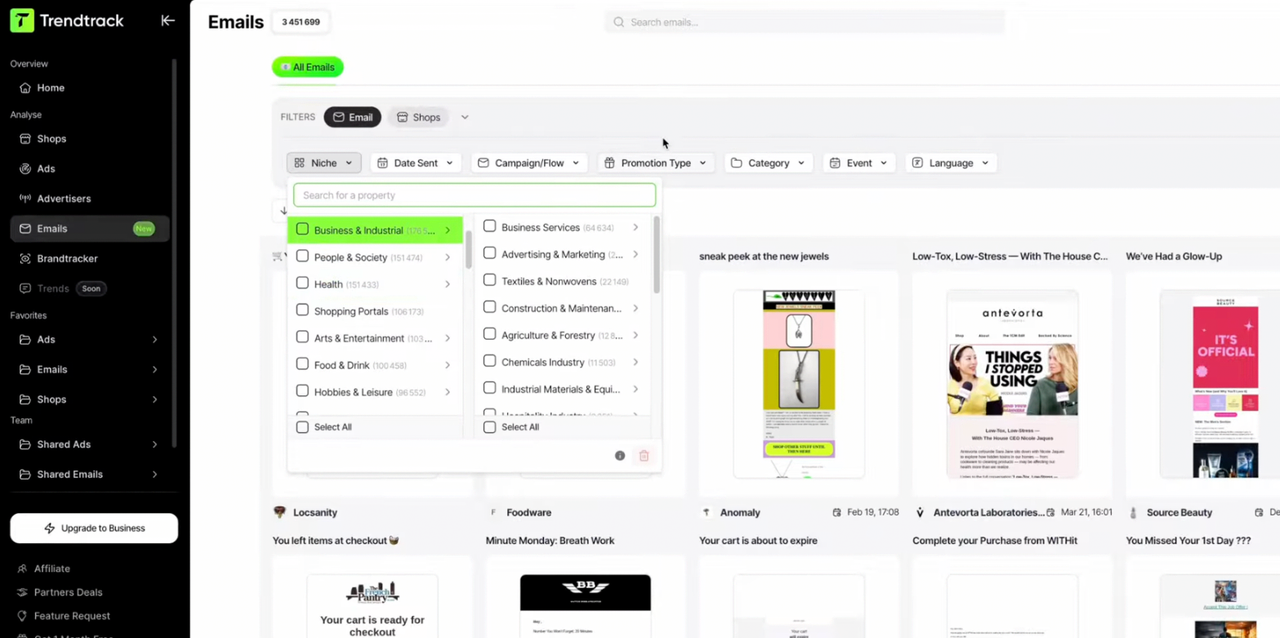
Email tracking is the rarest feature in this kind of tool. You see a brand's automated flows and campaigns. Some users use it to copy the structure of their competitors' best campaigns.
Brand Tracker: follow brands day to day
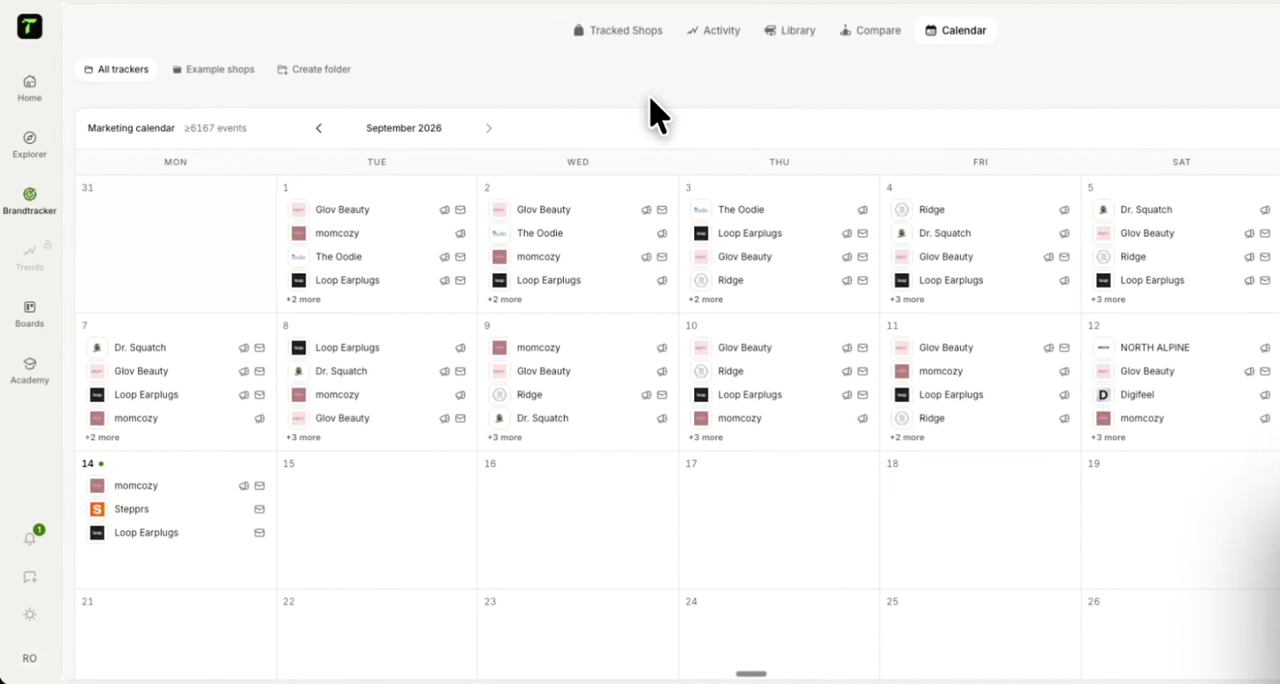
You follow a limited number of brands (from 2 to 20 depending on the plan) and get alerted when they launch new campaigns. The number of tracked brands is one of the main criteria for choosing a plan.
Claude integration
The higher plans give access to an API and a connector for AI assistants such as Claude, in read-only mode. Several users talk about it on X: they query Trendtrack's data through a simple conversation instead of handling filters.
How much does Trendtrack cost in 2026?
Here are the plans shown on the official pricing page. Prices are for annual billing.
Plan | Price (annual billing) | Users | Searches per week | Tracked brands |
|---|---|---|---|---|
Starter | $34/month | 1 | 5 | 2 |
Pro | $62/month | 1 | 30 | 10 |
Business | $111/month | 3 (then $29 per extra seat) | Unlimited | 20 |
Enterprise | Custom quote | Unlimited | Unlimited | Custom |
Trendtrack also offers monthly or quarterly billing: the discount is 15% for quarterly and 30% for annual, according to the official page. In other words, paying monthly costs more than the prices in the table.
Be careful with the figures you read elsewhere. Several comparison articles show prices of $59, $89 and $149 per month: they don’t match the current official monthly prices ($49, $89 and $159), so they probably come from an older price grid. The articles don’t agree on each plan’s quotas either, nor on the annual discount (20% or 30%). Trust the official page, not an article, including ours.
The real cost also depends on quotas: searches and filters use up a weekly allowance. If you explore a lot, the Starter plan runs out fast.
What users say
On the comparison articles, the Trustpilot rating quoted is around 4.7 to 4.8 out of 5, on a few dozen reviews: too small a sample to draw firm conclusions.
On X, here is what we read in September and October 2026. Each point links to the original post.
Positive feedback
- A Meta advertising specialist explains that they sort a competitor's ads by impact(opens in a new tab) instead of guessing from how long an ad has been running.
- Another calls the tool their new creative strategist(opens in a new tab) for preparing the fourth quarter.
- A media buyer likes the ranking trend curve(opens in a new tab): it helps spot new big advertisers, and therefore new formats that work.
- An e-commerce account finds it “essential for competitive monitoring”(opens in a new tab), and another professional replies that it has become “mandatory”(opens in a new tab).
- A creator presents a system that copies competitors' best email campaigns(opens in a new tab), built with Trendtrack data and Claude.
- The same seller who found the tool disappointing says, however, that their refund arrived fairly quickly(opens in a new tab) and thanks support for being responsive: useful to know, since there is no free trial.
Criticism
On X, we found two detailed negative posts. The first: a seller looking for products tried the subscription, found fewer stores, ads and products than with their free method, for about €100 per month(opens in a new tab), and asked for a refund. The second: an SEO and e-commerce account that had just taken a subscription says they are disappointed and finds the tool too expensive(opens in a new tab). The other criticisms come from the comparison articles:
- the price, with a large price jump between the Pro plan and the Business plan(opens in a new tab);
- the lack of a free trial or free version(opens in a new tab);
- the credit quotas(opens in a new tab): every filter and every results page uses some.
Read these posts with some distance. Some of the positive posts come from people who talk about it to attract an audience, and some come with a promo code, so a possible commission. What stands out: the tool is appreciated by people who use it every week for ad research.
Trendtrack's strengths
- All-in-one: stores, ads and emails in the same tool.
- Europe-focused: ad spend data for Europe and the United Kingdom, which American tools cover poorly.
- French-language interface and French-language support, reported by several comparison articles.
- Free Chrome extension to estimate a site's traffic and technology in one click.
- Email tracking: rare among competitors.
- API and AI connector to automate your monitoring on the higher plans.
Limits to know about
- No clear free trial: you pay before knowing whether the tool suits you.
- Search quotas: on Starter, 5 searches per week is not much.
- European data: outside Europe and the United Kingdom, reach and ad spend are not available.
- Estimates, not exact figures: traffic and spend are modeled.
- No guarantee of success: finding a product that sells for a competitor says nothing about your ability to sell it.
Who is Trendtrack for?
Trendtrack fits if you do competitive research regularly: a dropshipper looking for products, a media buyer watching advertisers, a brand following its direct competitors. It fits less if you are looking for a product idea just once, or if your market isn't European.
For the owner of an existing store, the value lies elsewhere than in product research: watching how brands in your niche structure their offers, pages and emails. Once you have spotted those ideas, your store still has to convert. A fast theme, clear bundles and a well-designed cart matter as much as advertising.
Trendtrack or Copyfy?
Copyfy is one of the most cited alternatives in France. It is also a French tool for dropshippers, but it doesn't cover the same need: it combines product research, ad monitoring, store analysis and AI Shopify store creation.
Trendtrack | Copyfy | |
|---|---|---|
Monthly price shown | $34 / $62 / $111 (annual billing) | €49 / €89 / €129 monthly; €30 / €54 / €78 annual |
Free trial | No clear trial | 5 days, no credit card |
Ad monitoring | Yes, with reach and spend (Europe, United Kingdom) | Yes |
Email tracking | Yes | Not mentioned |
AI store creation | No | Yes |
Platforms | Online stores, mostly Shopify | Shopify only |
Trustpilot rating quoted | Around 4.7 to 4.8 out of 5 | 4.4 out of 5 (133 reviews) |
Copyfy's prices come from its official page: some comparison articles show other amounts, for example €99 and €149 for the higher plans. Copyfy offers a 5-day free trial with no credit card, which Trendtrack doesn't seem to do. Its Trustpilot rating is 4.4 out of 5 on 133 reviews according to the sources we checked.
Its limits, according to those same sources: it only works with Shopify, the AI-generated stores are hard to customize, and accounts are individual.
Which one to choose? If you mainly want to follow the ad spend and emails of European brands, Trendtrack is more monitoring-oriented. If you want to find a product and launch a store quickly, Copyfy goes further on the launch side, and its free trial lets you form an opinion without paying.
Trendtrack alternatives
Tool | Strength | Worth knowing |
|---|---|---|
Copyfy | Product research, ad monitoring and AI Shopify store creation | 5-day free trial; Shopify only (see the comparison above) |
Minea | Product-by-product analysis and ad creatives | Often cited alongside Trendtrack rather than as a replacement |
Pipiads / AdSpy | Large ad databases, mostly the US market | Less useful for a French niche |
SimilarWeb | Website traffic across all industries | General-purpose, not focused on Shopify or ads |
Kalodata | Products that sell on TikTok Shop | Different ground: selling through TikTok, not the Shopify store |
Google Trends | Free, search trends | No data on stores or ad spend |
Our verdict
Trendtrack is a good monitoring tool if you use it every week and your market is European: it bundles stores, ads and emails at a lower price than equivalent American tools. The most reasonable approach is to start with a short plan, measure how many searches you really use, then switch to annual billing only if the tool becomes part of your routine. Since Copyfy offers a 5-day free trial, test it before choosing.
If you remember only one thing: Trendtrack shows what others are doing, but selling depends on the quality of your store.
Frequently asked questions
Is Trendtrack free?
No. The three public plans are paid (Starter, Pro, Business) and the comparison articles we checked don't mention a clear free trial. The Chrome extension is presented as free. Check the pricing page before committing: the offer changes often.
Which Trendtrack plan should I choose?
To test a niche from time to time, Starter is enough, but its 5 searches per week get used up fast. Pro is the plan that suits most sellers who do regular monitoring: 30 searches per week and 10 tracked brands. Business is for teams, with 3 users.
Does Trendtrack replace Minea?
Not necessarily. Both tools do e-commerce monitoring, but they don't emphasize the same things. Trendtrack starts from stores and their ad spend; Minea starts more from products and creatives. Some sellers pay for both.
Is Trendtrack data reliable?
They are estimates. They combine Meta's ad transparency with traffic data, among other sources, and don't replace a store's real figures. Use them to spot trends and compare stores with each other, not to set a budget down to the cent.
Does Trendtrack work outside Europe?
Reach and ad spend data come from the ad transparency of the European Union and the United Kingdom. If your market is elsewhere, the tool will be less accurate.
Do I need a Shopify store to use Trendtrack?
No, you just need to want to analyze stores. That said, the tool is mainly designed for Shopify stores, and that is where its data is richest.

Keep reading

Snap Bundle vs BOGOS: The BOGOS Alternative for Volume Discounts & Quantity Breaks (2026)
Snap Bundle vs BOGOS compared on pricing, order caps, bundle types and BOGO offers, with a side-by-side look at both Shopify App Store listings.

10 Best Volume Discount Shopify Apps in 2026 (Tested)
The 10 best Shopify volume discount apps for 2026, compared on free plans, pricing as you grow, and features, from Snap Bundle to Kaching and Fast Bundle.

What Are Bundles in Ecommerce? Types, Examples and Pricing
What are bundles in ecommerce? The 7 types of product bundles, real examples, how to price them without losing margin, and how to create a Shopify bundle.